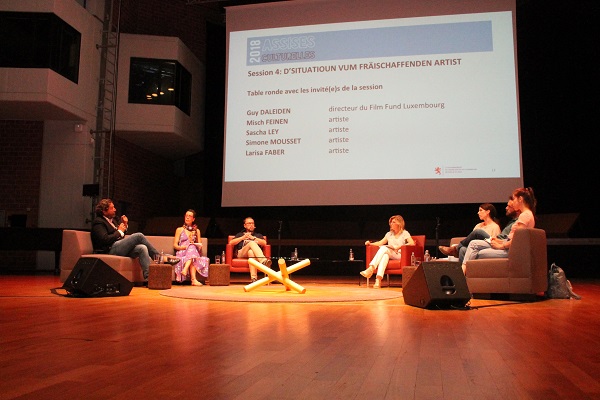
 (L-R): Guy Daleiden, Sascha Ley, Claude Mangen, Christiane Kremer, Simone Mousset, Misch Feinen, Larisa Faber;
Credit: MCULT
(L-R): Guy Daleiden, Sascha Ley, Claude Mangen, Christiane Kremer, Simone Mousset, Misch Feinen, Larisa Faber;
Credit: MCULT
Almost 400 people attended the 2018 "Culture Assises" event which took place on Friday 29 and Saturday 30 June 2018 at the Conservatoire de la Ville de Luxembourg.
During the first day, Luxembourg's Secretary of State for Culture, Guy Arendt, and PDC Coordinator, Jo Kox, presented in detail the state's cultural development plan which has been drafted on the basis of the consultations that were organised as part of the Bourglinster reflection groups, the 2016 Culture Assises and the "Thursday Workshops". The resulting document is the result of a process of co-creation that took place, in stages, over almost two years.
Covering almost 200 pages, the cultural development plan draws up an inventory of fixtures and presents observations and objectives divided into 6 chapters. The document outlines 61 recommendations that should help better structure the cultural scene and prepare it for future challenges.
During three sessions, the themes "A cultural development plan for Luxembourg", "Recognition of and in culture" and "The situation of the independent artist" were discussed in round tables and debates.
At the closing of the "Culture Assises", Luxembourg's Prime Minister and Minister of Culture, Xavier Bettel, stressed the importance of culture as a vital element of a dynamic society and committed to promote the entire sector through the Cultural Development Plan: "Cultural spending is an investment and not an expense".
Secretary of State for Culture Guy Arendt closed the meeting by thanking all those who participated in the consultation and writing of the cultural development plan: "This plan is the beginning of a process and policy as well as the entire cultural sector will have to work together when it comes to implementation. It is important for us to maintain the dialogue and it seems to me essential to organise biennial meetings to ensure that the development plan can bear fruit."
The first version of the development plan is available online and cultural stakeholders and anyone interested can submit feedback up to 31 July. The final version of the plan will be presented at the end of September.