The Council's Permanent Representatives Committee today agreed its position on the draft of the EU budget for 2016, on the basis of a compromise text from the Luxembourg Presidency.
The Council supported the funds proposed by the Commission for a number of priority areas, including the European fund for strategic investments (EFSI) for boosting the economy; measures for the management of migration flows; humanitarian aid and Erasmus. The Council's position also reflects the payment plan agreed with the European Parliament in May 2015 to phase out the backlog of outstanding payment claims for the 2007-2013 cohesion programmes.
"I am confident that the Council’s position on the 2016 EU draft budget provides appropriate resources to mobilise productive investments, boost growth and employment and responds to the most politically pressing needs such as migratory management," said Pierre Gramegna, Luxembourg's Minister for Finance and President of the Council. "In today’s economy it is of paramount importance that citizens get value for their money and that EU resources are used with accuracy and accountability. Therefore I believe that the Council’s political agreement strikes the right balance between fiscal consolidation and strategic investments that Europe needs to mitigate the negative effects of the current economic and social situation."
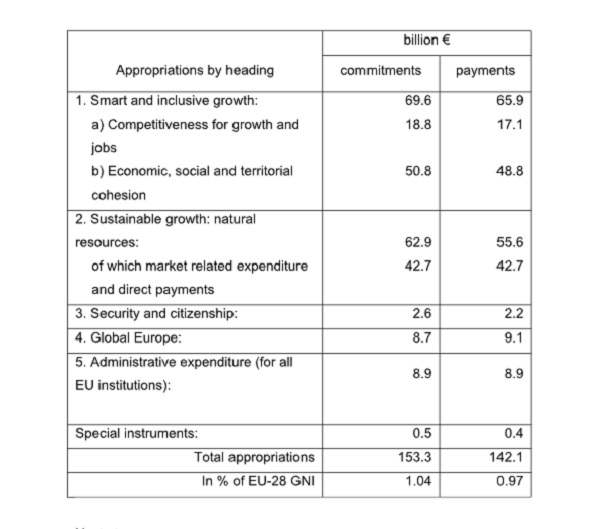
The Council stated that due to the multiple political and financial challenges currently faced by the EU, an adequate economic margin must be incorporated to allow the EU to react to any unforeseen needs. However, it proposed €153.27 billion in commitments and €142.12 billion in payments would be sufficient in enabling the EU to reach its 2016 policy objectives, which represents €563.6 million in commitments and €1.4 billion in payments less than was put forward by the Commission.
The Council's position provided for a decrease in total commitments of 5.36% and an increase in total payments of 0.59% compared to the 2015 EU budget as amended by amending budgets no 1-5. Commitments of €16.5 billion were recently added to the 2015 budget to safeguard appropriations which in 2014 remained unused due to the late adoption of certain MFF programmes. Concerning payments, the Council's position offered two digit growth rates for external policy actions (+22.5%) and for measures related to security and citizenship, such as migration (+15.4%). Research and other measures aimed at increasing competitiveness benefitted from an increase of 8.6%.
The Council is expected to formally adopt its position by written procedure at the beginning of September 2015. It will serve as a mandate to the Luxembourg Presidency to negotiate the 2016 EU budget with the European Parliament.
Photo by Ministry of Finance