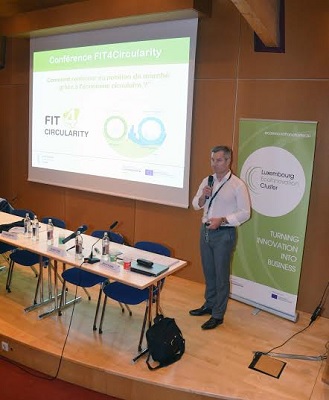
On Tuesday 7 July 2015, the Luxembourg EcoInnovation Cluster held a talk entitled 'Comment Renforcer sa Position de Marché Grâce à l'Economie Circulaire?' ('How Can You Strengthen Your Market Position Through the Circular Economy?') as a means of demonstrating to the forty companies present how to employ this approach whilst retaining economic and environmental requirements.
A circular economy seeks to keep resources for as long as possible, extracting their maximum potential, and regenerating materials as a means of combatting the wastefulness of a linear economy. Marcel Klesen, Luxembourg EcoInnovation Cluster manager at Luxinnovation, demonstrated how the optimal use of resourced and the reduction in need for raw materials is becoming increasingly critical, stating, "There is no Plan B - because there is no Planet B."
"The circular economy is a revolution of the whole economic process," continued Romain Poulles, President of the Cluster. "It has an impact on the choice of raw materials, which are then selected for their positive impact and can be reused after the end-of-life of the initial product. The products are designed to be repaired, reused, then decomposed so that the components can be used to make others."
"It is not a perfect circle: some products will be converted into others," added Christian Tock, Directorate of New Technologies at the Ministry of Economy, making the point that resulting products should not be of lower quality, which is sometimes the case with recycled products today.
According to Tock, a central issue of the circular economy is to replace the costs of raw materials, which often come from re,ote and unstable regions, with the cost of hiring new staff locally. The circular economy hold the potential to create new jobs in the recovery, repair and renovation of products, as well as produce new business models based on renting or sharing equipment rather than buying it, for example.
One of the members of the Cluster, the Tarkett company, has been recycling since 1957 and made the strategic decision in 2009 to move towards a circular economy. The company, a leader in innovative solutions for flooring and sporting surfaces, created a model which responds to resource shortages and the growing urbanisation of the world, without compromising helath and well-being in its buildings. Its approach is multifold, performed through material selection, production and responsible management of resources such as energy.
The EcoInnovation Cluster stated that informing companies of the opportunities to be had through a circular economy, and encouraging them towards such an action, remains their top priority. Luxinnovation has announced plans to launch a programme in autumn to support, in particular, small to medium sized businesses in their move towards a circular economy approach.
Photo by Luxinnovation (Marcel Klesen, Luxembourg EcoInnovation Cluster Manager at Luxinnovation)