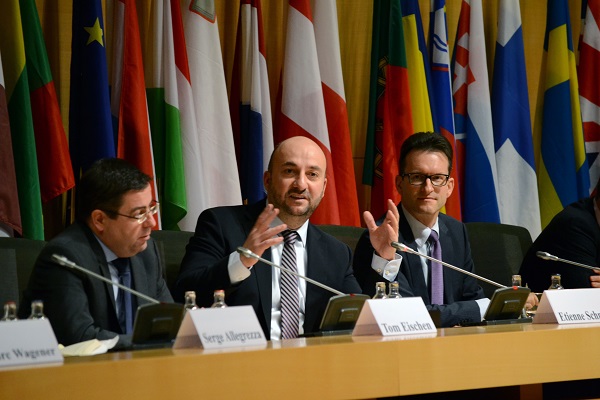
The first step towards the implementation of a Third Industrial Revolution was taken Thursday with a public briefing open to all interested individuals, organisations and institutions.
The launch of a strategic study, first announced at the Luxembourg Sustainability Forum held in September 2015, was initiated by the Ministry of the Economy alongside the Chamber of Commerce and Inspiring More Sustainability (IMS) Luxembourg. The so-called 'Third Industrial Revolution' process is characterised by the transition to a new business model defined by a particular approach coupling information technology, renewable energies and intelligent transport networks and to derive a coherent overall strategy.
This latter aspect, of identifying and facilitating the long-term establishment of this new economic model in Luxembourg, was placed in the hands of American economist Jeremy Rifkin, whose 2011 book on the subject outlined a world with adaptable intelligent systems, the efficient allocation of resources and an interconnection of systems.
At the public information session held at the Chamber of Commerce on Thursday, a call was launched for all socio-economic actors concerned with the challenges of the Third Industrial Revolution to indicate their interest in participating in the process by registering themselves to one of the nine themed working groups here before 31 January 2016.
These working groups will focus on the challenges involved such as energy, mobility, construction, food, manufacturing, finance, smart economy, the circular economy as well as the prosumer and social model. Interested parties also have the opportunity to submit written ideas and thoughts relating to a relevan topic for the aforementioned working groups on the website. This 'bottom-up' approach aims to lend a voice to any actor concerned with the process and in so doing integrate the know-how of various national actors.
Jeremy Rifkin and his team of experts will help sketch a roadmap towards a more interconnected and sustainable ecoomy, taking into account the socio-economic specificities of the country. The final objective of the process is to achieve an operational action plan suggesting proposals and concrete actions.
Photo by MECO (L-R: Tom Eischen, Ministry of the Economy; Étienne Schneider, Deputy PM, Minister of the Economy; Carlo Thelen, Director-General of the Chamber of Commerce)