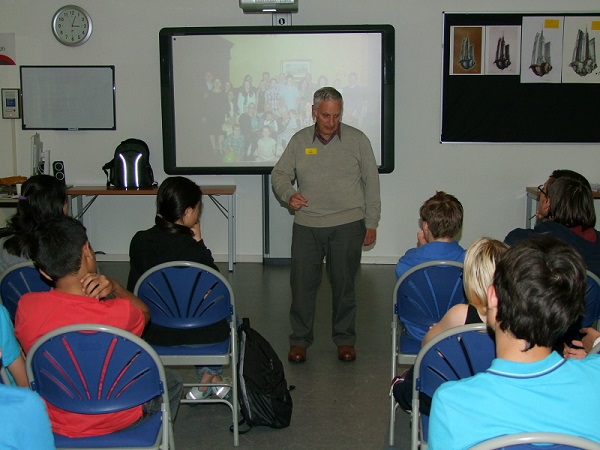
On Wednesday, 81 year-old Steven Frank was at St George's International School in Luxembourg-Hamm to address secondary pupils, having also addressed parents and staff on Tuesday evening, in association with the Parent Support Group for the English-speaking Community in Luxembourg (Passage), informing them of his stories as a Holocaust survivor.
Steven Frank is a Holocaust survivor and only one of 93 children who remained alive following the atrocities at the Thereienstadt Concentration Camp during the Second World War.
His personal story of survival, despair, ingenuity and ultimate hope started by providing some background to his family. He explained that his father originated from east of Amsterdam in the Netherlands and studied law at the University of Leiden, and his mother was a musician in England who went to Amsterdam to a finishing school. They met in The Netherlands and he was born there.
He talked about the German occupation of the Netherlands during WWII and how different members of his family - cousins, etc. - went into hiding, with various anecdotes outlining the different ways in which they hid from the Nazis. He presented a slide-show of photographs of his parents' wedding day and from when he was young, often with his elder brother.
When the Nazis invaded, they got details of all Jews from the Civil Service which had undertaken a recent census. For Jews working in the civil service, they were all let go and tried to get work in private houses, etc. In 1941, everyone in the Netherlands was issued with an identity card, with Jews having their card stamped. Jews were not allowed in certain areas, e.g. public parks, restaurants, libraries, football matches. In January 1942 all Jews in the Netherlands were ordered to move to a suburb of Amsterdam. In June, all bank accounts of Jews were appropriated and shops, cars and bicycles owned by Jews were confiscated, shopping hours were restricted.
Around this time, the Nazis in Germany set up a plan on how to destroy all Jews in Europe: eventually, 6 million Jews were massacred.
His slide-show presentation continued with a collection of photographs and documents from that time, all of which told part of the story. Jewish children had to attend Jewish schools, all Jews had to wear a star on their clothes when outside; those who were caught not wearing them were shot.
Why did they not simply leave Holland? He explained that his father, an eminent lawyer, wanted to stay. He was on the board of a hospital for handicapped Jews and he felt that he had to stay to help them, as they would be one of the first to be caught by the Nazis. His father also joined the resistance and helped people escape, some over the Alps to Switzerland. One day he left for work and was never seen again. He was imprisoned and tortured before being sent to Auschwitz where he was exterminated in 1943 aged just 39.
His mother opened their house for a Jewish school and she also cut men's hair to make some money. They then received notification that they would be re-housed, to a castle in south-east Holland, along with various other Jews, all well-schooled and qualified. Around 6-8 months later they were bundled together and brought to a camp in the north-east, surrounded by a moat and barbed wire, with guards armed with machine guns. This turned out to be the Westerbork Transit Camp.
He descibed conditions as overcrowded and very unhygienic, with little food, where everyone had to fend for themselves, keep out of trouble and stay out of the way of the guards. Every Tuesday a transport would leave with up to 2,000 people.
He spoke of how he had picked up an intestinal worm at the transit camp which took 18 months to get rid of at the Great Ormond Street Hospital in London after the war.
He befriended a man who was growing tomatoes outside the barracks; later, the man asked Steven to look after them when he was on the next transport out of the camp.
He and his mother and brothers were on a later train for Theresienstadt in what was then Czechoslovakia, which had been built in 1780 as a garrison town and was then used as a Concentration Camp; he described the conditions as cramped and appalling. The camp was originally designed for up to 8,000 soldiers but now was where 40,000 Jews were accommodated. He told how they would make up packs of 52 playing cards, how they would collect and swap razor blades. Food was rationed to two slices of black bread per day; he described how being hungry pained.
Theresienstadt became infamous as the International Red Cross eventually were allowed in and the Nazis used the occasion as propaganda which included putting on a performance of Verdi's Requiem. Photographs of working in the vegetable garden did not reveal that the produce was actually destined for the camp guards.
He also recalled how he and others climbed through attics and came across a room with piles of clothes, etc., that had been taken from Jews before they were sent to extermination camps.
Early one morning, around 04:00, many children were led to the crematorium and a tunnel, where they were part of a chain to pass boxes of ashes towards the river where they were being dumped so as to remove evidence. Shortly afterwards, the Russians liberated the camp; the International Red Cross came in and helped bring disease and infections under control.
Of the 15,000 children who went to Theresienstadt, just 93 survived. He also mentioned that some of his family's belongings can be viewed at The National Holocaust Centre and Museum near Nottingham in England.
Photos by Geoff Thompson