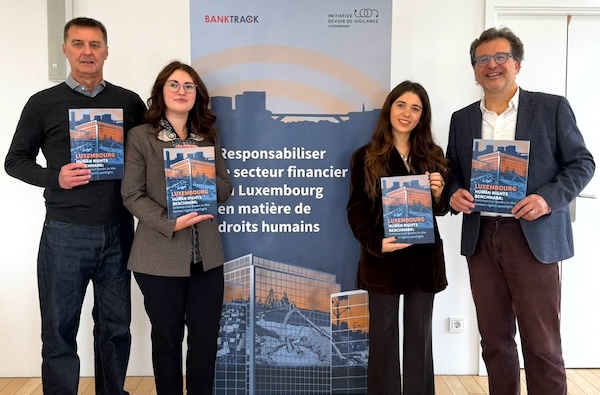
 Group photo;
Credit: IDV and BankTrack
On Tuesday 10 November 2026, the Initiative for a Duty of Vigilance (IDV) and BankTrack presented a new study revealing significant shortcomings in human rights practices among twelve major commercial banks operating in Luxembourg.
The study, entitled "Luxembourg Human Rights Benchmark: Commercial Banks Through the Lens of Human Rights", assessed the banks against fifteen criteria based on the United Nations (UN) Guiding Principles on Business and Human Rights (HR).
The banks achieved an average score of 5.2 out of 15, below the global average of 5.9 recorded in BankTrack's 2024 assessment of fifty banking groups worldwide. None of the twelve banks reached the "leader" category, while eight scored less than half of the available points.
According to the findings, banks performed best in policy commitments, achieving 62.5% of the available points. However, their scores were considerably lower for human rights due diligence (36.7%), reporting (33.3%) and remediation measures (11.5%).
The study also found that half of the banks provided no evidence of consulting people or communities potentially affected by their financing activities. Ten of the twelve institutions did not demonstrate that they assess whether they have caused or contributed to negative impacts.
None of the banks provided public evidence of implementing or facilitating remediation measures for harm linked to their activities, while none demonstrated that their complaints mechanisms fully meet the effectiveness criteria established by the United Nations.
The ten subsidiaries of international banking groups included in the assessment relied heavily on policies established by their parent companies, making it difficult to determine how these measures are implemented in Luxembourg.
Lucilla Viola, human rights research consultant at BankTrack, commented: "This study sends a clear message: the banks assessed in Luxembourg reflect a global trend of insufficient performance in respecting human rights." She added that banks had failed to demonstrate effective systems for identifying their impacts, particularly on vulnerable communities, or ensuring corrective measures when harm occurs.
In December 2022, the UN Working Group on Business and Human Rights called on Luxembourg to strengthen its position in sustainable finance by fully integrating human rights, environmental protection and climate change considerations.
Jean-Louis Zeien, co-coordinator of the IDV, said Luxembourg now has an opportunity to strengthen accountability through the transposition of the EU Corporate Sustainability Due Diligence Directive (CSDDD) into national law.
The IDV called on commercial banks to strengthen human rights due diligence, improve transparency about the impacts of their financing activities and establish accessible complaints mechanisms for affected communities.
It also urged the Luxembourg government to introduce due diligence requirements for the financial sector, place human rights at the centre of its sustainable finance strategy and lead by example through banks in which the state holds a stake.
The study further called on the Luxembourg Bankers' Association (ABBL) and the Luxembourg Sustainable Finance Initiative (LSFI) to promote international standards and develop practical tools to improve transparency, due diligence and access to remedies.
The research was commissioned by the IDV, a Luxembourg civil society network comprising seventeen NGOs, trade unions and organisations promoting corporate accountability, and conducted by BankTrack and human rights research consultant Lucilla Viola. All twelve banks were invited to comment on their provisional results, with seven participating in the exchange.