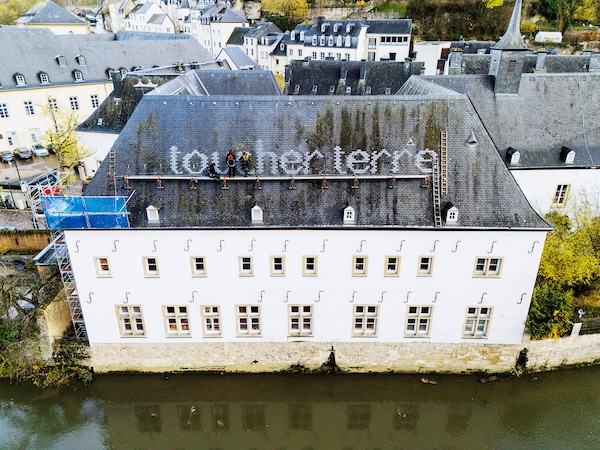
 The Luxembourg National Museum of Natural History (MNHN – Naturmusée) displays the message "TOUCHER TERRE" ("touch the earth") on its rooftop;
Credit: MNHN – Naturmusée
Since Thursday 19 November 2026, the Luxembourg National Museum of Natural History (MNHN – Naturmusée) in Luxembourg-Grund has displayed the message "TOUCHER TERRE" ("touch the earth") on its rooftop, an “artistic intervention” by Leonora Bisagno and Bruno Baltzer.
According to the MNHN, the message will remain in situ for one year and is part of the anniversary year celebrations marking 30 years since the Naturmusée moved into the former Saint-Jean hospice in Luxembourg-Grund.
The museum previously had to move several times within the city (a natural history cabinet opened in 1854 at the former Athénée, followed by a move of the collections and exhibitions to the former Vauban barracks in the Luxembourg-Pfaffenthal in 1892, then, from 1922 to 1995, premises shared with the Museum of History and Art in the buildings at the Fish Market, today the Nationalmusée um Fëschmaart.
An invitation to reconnect with the earth
The MNHN says TOUCHER TERRE is, “a sensitive invitation for us humans to reconnect with the earth in the full breadth of its meanings: astronomical, geophysical, societal, territorial or geographical, and above all geological and ecological, to get to know it and to love it. It also touches on a vital question for our societies, in which all of us, as citizens, must indeed ‘land’ and take back control of our connection with the nature that surrounds and feeds us. To touch the earth, then: why not lie on the ground and observe the life that pulses around us from ground level. Touch, as the art of the tangible, of creation and of positive transformation together with the living world, is inscribed here. TOUCHER TERRE sediments earthly, concrete thoughts for our present.”
A minimal and reversible intervention
The piece follows previous works displayed by the MNHN, including SI JE ME SOUVIENS (2019, Montreal, Canada), AU-DELÀ (2021, Briançon, France) and LE NOSTRE STORIE (2023, Florence, Italy), and is a non-permanent, non-invasive project.
The work, approximately 2 m x 17 m in size, consists of simply turning over the existing roof slates, in place for 30 years and often covered in moss, subtly revealing the message through a set of pixelated letters. The museum describes the work as almost "photographic”, in that the turned slate is blank, like a sensitised paper that has never been exposed to light, among other slates blackened by light and the weather.
The MNHN said the work meets the requirements and principles that underpin and guide the protection of properties inscribed on the World Heritage List, and particularly their Outstanding Universal Value, their authenticity, their integrity, and the principles of reversibility and minimal intervention that guide the conservation of cultural heritage. The work is intended to blend delicately and temporarily into the urban setting of the Luxembourg-Grund district, respecting the colours of the façades and roofs of the museum and the neighbourhood.