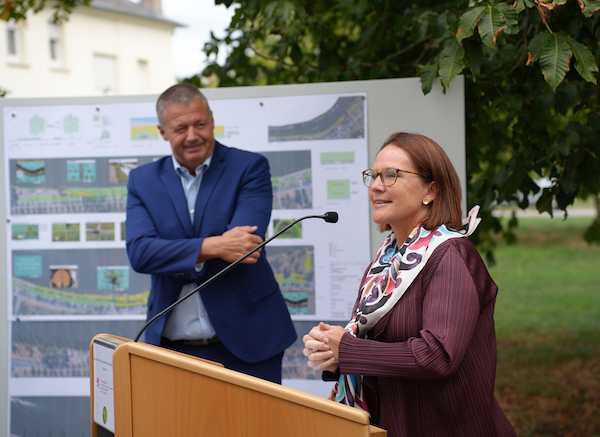
 Yuriko Backes, Luxembourg Minister for Mobility and Public Works; Michel Gloden, Mayor of the Municipality of Schengen;
Credit: MMTP
Yuriko Backes, Luxembourg Minister for Mobility and Public Works; Michel Gloden, Mayor of the Municipality of Schengen;
Credit: MMTP
On Friday 25 September 2026, Luxembourg’s Ministry of Mobility and Public Works reported on the official inauguration of the Bamléierpad (Tree Trail) in Bech-Kleinmacher.
The ceremony, which took place on Thursday 24 September, was attended by Minister for Mobility and Public Works Yuriko Backes, the mayor of the Municipality of Schengen, Michel Gloden, representatives of the municipality and the Roads Administration, as well as a school class that came to discover the site and take part in this day dedicated to raising awareness of nature and the environment.
The ministry detailed that the Bamléierpad has become a unique place in Luxembourg over the decades. Located in Bech-Kleinmacher, between the Moselle and the N10 national road, this approximately one-kilometre educational trail is now home to more than 300 trees representing more than 60 different species. It showcases the richness of Luxembourg's tree heritage while also helping to prepare for the plantings of tomorrow.
“The trees we plant today will help shape the living environment and resilience of our territories for generations to come. The Bamléierpad not only allows us to discover the remarkable diversity of the world's tree heritage, but also to observe which species will be most resilient in the face of future climate challenges. This project demonstrates that by combining knowledge, biodiversity and local commitment, we can create spaces that are useful, inspiring and forward-looking,” emphasised Minister Backes.
A place shaped by history and cooperation
The history of the Bamléierpad dates back to the canalisation works on the Moselle carried out in the 1960s. The land developed between the Moselle and the current N10 national road was gradually transformed into an area dedicated to tree diversity. From the mid-1970s onwards, regional teams from the Roads Administration planted the first trees with a clear ambition: to create a collection as diverse as possible, extending well beyond the range of species traditionally found in Central Europe.
This vision developed over the decades through close cooperation between the Roads Administration and the municipality of Bech-Kleinmacher, which is now part of the Municipality of Schengen. Together, the two partners gradually enriched the site and strengthened its educational and environmental purpose.
An invitation to discover nature differently
The redevelopment undertaken in 2019 gave the trail a new lease of life. New identification and information signs were installed, while several educational and ecological stations were added to enhance the visitor experience. Insect hotels, areas managed extensively to promote biodiversity, stations displaying sections of wood, signs dedicated to trees and ecological interactions, as well as resting areas, now line the route.
“With the Bamléierpad, the Municipality of Schengen has a new asset that combines nature, education and tourism. This trail allows tourists to discover the exceptional richness of the site while providing the local population with a place to meet, walk and relax in the heart of a preserved environment. We are particularly pleased to see this project strengthen the attractiveness of our region while bringing citizens closer to nature,”said Michel Gloden.
An open-air laboratory for the trees of tomorrow
Beyond its recreational and educational role, the site also plays an important role in consideration of how plantings can be adapted to future climatic conditions. More frequent periods of drought, high temperatures and extreme weather events represent growing challenges for trees planted along roads and in urban areas. In this context, choosing species capable of adapting to climate change is becoming a major concern for local authorities and infrastructure managers.
Thanks to the exceptional diversity of species present there, the Bamléierpad provides a valuable observation site for improving understanding of how different trees behave under local conditions. The site therefore helps identify the species best suited to future climatic conditions and those that could become the trees of the future in tomorrow's public spaces.
A project focused on future generations
At the intersection of nature, education and innovation, the Bamléierpad illustrates how a project developed over the long term can create genuine added value for the community.
The ministry added that through this project, the Roads Administration and the Municipality of Schengen reaffirmed their shared commitment to preserving natural heritage, raising public awareness of biodiversity and preparing the territories for future environmental challenges.