 Credit: Fondation Hëllef fir d’Natur
On Wednesday 30 September 2026, Luxembourg’s Hëllef fir d’Natur Foundation provided an update on its conservation project to breed freshwater pearl mussels and thick-shelled river mussels in captivity.
Since 2005, the Fondation Hëllef fir d’Natur has been working to breed freshwater pearl mussels and thick-shelled river mussels in captivity. The breeding programme has now resulted in a conservation success: hundreds of thick-shelled river mussels have survived and reproduced.
According to the environmental organisation, six native species of large freshwater mussels live in Luxembourg. Many populations have declined sharply due to deterioration in water quality and the loss of suitable habitats. The freshwater pearl mussel, for example, is now considered to have disappeared from the Our and the Sauer. Small remnant populations of thick-shelled river mussels still exist in both rivers.
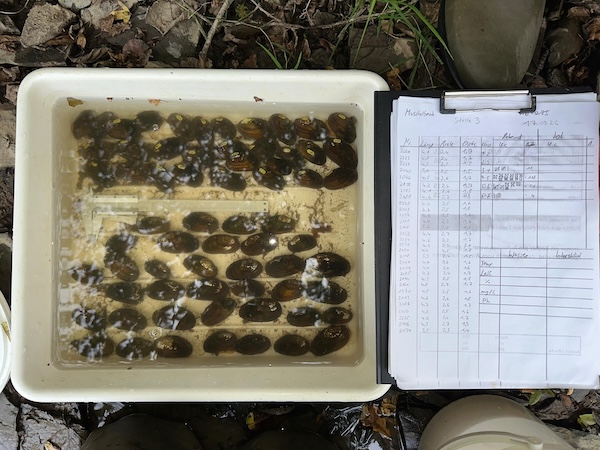
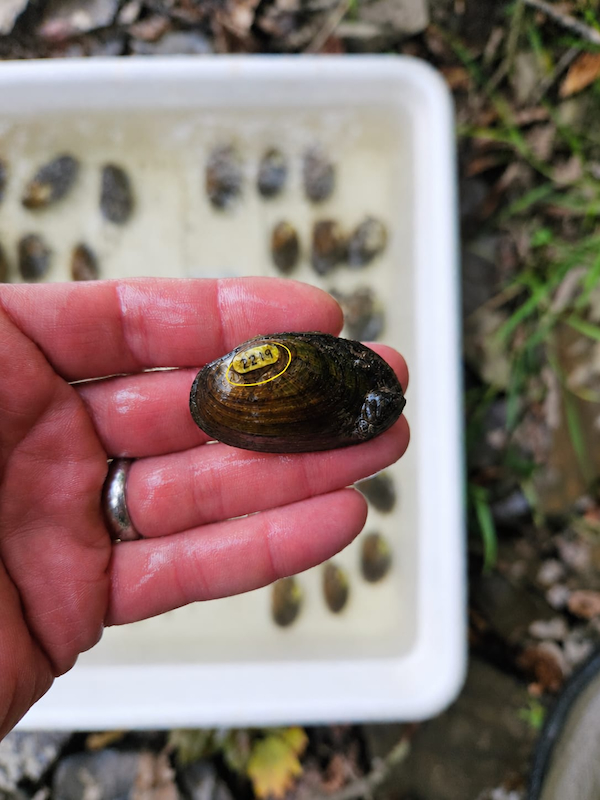
Hëllef fir d’Natur said this is the reason its latest assessment represents a particular success for species conservation: between 2018 and 2021, its team released a total of 1,170 thick-shelled river mussels (Unio crassus) bred at the Kalborn Mühle breeding station into the Our. Of these, 1,053 mussels were marked so that their survival could subsequently be monitored. During follow-up checks carried out in 2026, 115 marked mussels and a further 754 unmarked mussels were recorded.
The mussels, which are now ten years old, have not only survived but have also grown considerably. Hëllef fir d’Natur said the fact that only 10% of the originally marked mussels were found again does not, however, mean that the other 90% did not survive. Over time, they have simply moved away from their original location. No marked empty shells were found during the latest survey.
The mussels, now around ten years old, have therefore not only survived but have also achieved considerable growth, which is an encouraging indication of the success of the reintroduction measures in the Our.
Hëllef fir d’Natur noted that the current assessment of its thick-shelled river mussels in the Our shows that this long-term work is paying off. At the same time, the protection and ecological enhancement of the Our remain essential to ensure that the mussels continue to find suitable living conditions there. These measures benefit numerous other aquatic organisms as well as the mussels, which is why the Fondation Hëllef fir d’Natur stated it will continue to work to improve the habitat.
Hëllef fir d’Natur said: “It was only in June that we had the opportunity to present our mussel breeding station to His Royal Highness Grand Duke Guillaume, which makes such a positive result all the more pleasing to us this year.”
Since 2005, endangered freshwater mussels have been bred at the Kalborn Mühle breeding station, including the thick-shelled river mussel (Unio crassus) and the freshwater pearl mussel (Margaritifera margaritifera).
Hëllef fir d’Natur detailed that breeding is a complex process: the tiny mussel larvae initially develop on host fish and are then raised for several years under controlled conditions using single-celled algae. Once they reach a size of approximately 1.5 to 3 centimetres, the young mussels are released into suitable watercourses.
Since 2017, more than 20,000 young mussels have been successfully released.
Further information on the conservation project can be found at https://www.kalbermillen.lu/kalborner-muehle/muschelzucht-station/
Credit: Fondation Hëllef fir d’Natur