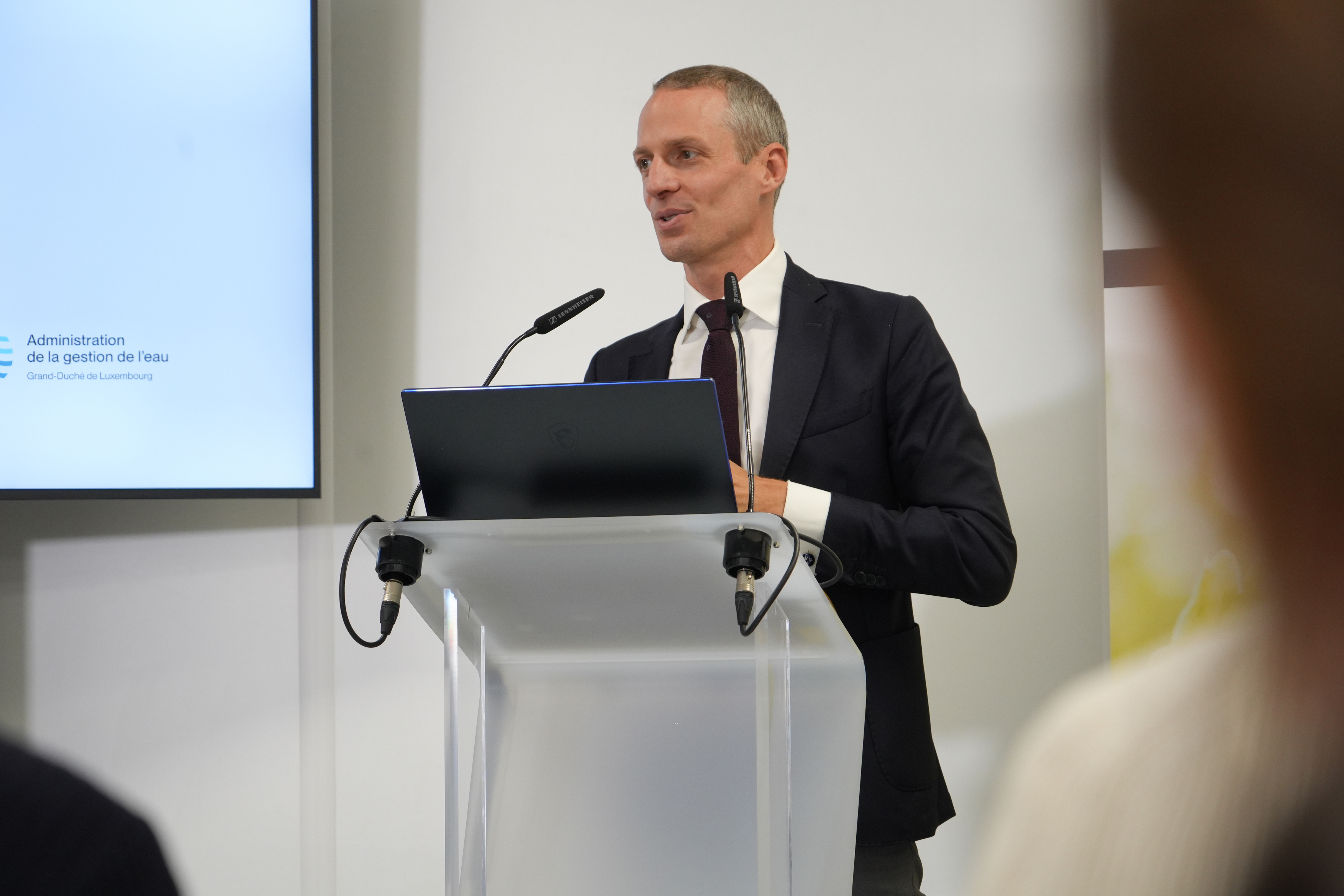
 Serge Wilmes, Luxembourg’s Minister of the Environment, Climate and Biodiversity;
Credit: MECB
Serge Wilmes, Luxembourg’s Minister of the Environment, Climate and Biodiversity;
Credit: MECB
On Thursday 8 October 2026, Luxembourg's Ministry of the Environment, Climate and Biodiversity and the Water Management Administration presented the country's hydrological situation and the updated version of the inondations.lu website during a press conference entitled “Prett fir den Hierscht” (ready for autumn).
“Faced with the effects of climate change, it is essential that everyone has access to clear and reliable information, knows how to protect their home and understands how to respond in the event of flooding. The State supports residents in these preparations, including through financial assistance to protect their homes. Together, let us prepare today to better cope with the realities of climate change,” emphasised Serge Wilmes, Luxembourg’s Minister of the Environment, Climate and Biodiversity.
According to the ministry, the lack of rainfall during summer 2026 led to exceptionally low water levels in rivers and streams, particularly in northern Luxembourg. The administration subsequently mapped dried-up watercourses to assess the extent of the drought, with several monitoring stations recording some of the lowest flow rates on record.
To protect aquatic ecosystems and surface water resources, a temporary ban on water abstraction from watercourses, except the Moselle, has remained in force since 8 July 2026.
Despite rainfall in late August and early October 2026, the ministry reported that water levels remain low across much of the country's river network.
Although drought has dominated recent months, the risk of flooding remains a reality. Severely dried-out soils absorb water less effectively, increasing surface runoff during heavy rainfall and consequently raising the risk of flooding.
To improve public access to information, the administration has launched an updated version of the inondations.lu website.
According to the ministry, developed in close collaboration with the State Information Technology Centre (CTIE), the website offers more intuitive navigation and easier access to essential information. Residents can consult water levels in rivers and streams, hydrological forecasts and alerts issued through the national warning and information system LU-Alert.
To support adaptation to flood risks, the ministry further said that it offers subsidies through the Water Management Fund to property owners wishing to protect their buildings against flooding.
These subsidies cover up to 75% of eligible costs, subject to the following maximum amounts:
-
€20,000 for single-family homes;
-
€45,000 for multi-family residential buildings;
-
€75,000 for buildings used for commercial, economic, cultural or public purposes.
The subsidy application must be submitted before purchasing equipment or carrying out the work, while a brochure outlining the available financial assistance can be consulted on emwelt.lu and waasser.lu.
The authorities emphasised that preparing in advance is one of the most effective ways to limit flood damage. In the event of a flood warning or rising water levels, residents are advised to:
-
raise household appliances and sensitive equipment above potential flood levels;
-
move vehicles out of flood-prone areas while it is still possible;
-
avoid flooded roads and areas near watercourses;
-
charge mobile phones and portable power banks;
-
switch off electricity in rooms that may be flooded;
-
secure heating oil tanks to prevent pollution;
-
avoid any action that could endanger their own safety or that of others.