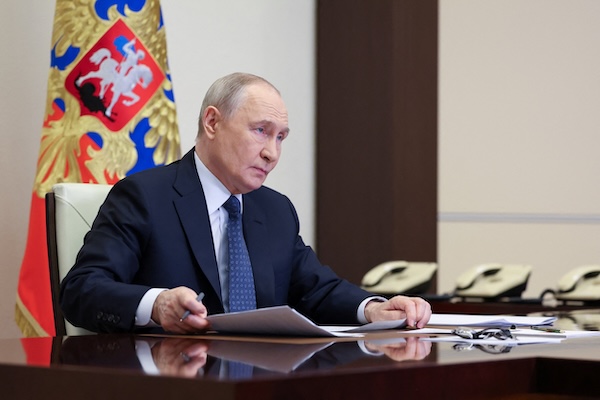
 Russian President Vladimir Putin holds a meeting on the situation in Dagestan, which was hit by severe flooding, via video link at the Novo-Ogaryovo state residence outside Moscow, Russia 7 April 2026;
Credit: Sputnik/Alexander Kazakov/Pool via Reuters
Russian President Vladimir Putin holds a meeting on the situation in Dagestan, which was hit by severe flooding, via video link at the Novo-Ogaryovo state residence outside Moscow, Russia 7 April 2026;
Credit: Sputnik/Alexander Kazakov/Pool via Reuters
(Reuters) - On Thursday 9 April 2026, Russian President Vladimir Putin announced a 32-hour ceasefire over a two-day period for Orthodox Easter and his Ukrainian counterpart Volodymyr Zelensky said Kyiv would abide by the measure.
The ceasefire for Orthodox Easter celebrations on Sunday 12 April 2026 coincides with a pause in US-led efforts to clinch a settlement to the four-year-old conflict amid hostilities in Iran and the broader Middle East.
Putin's announcement was similar to a 30-hour ceasefire he ordered last year. Each side accused the other of violating it.
The Kremlin said the Easter ceasefire would be in effect from Saturday at 16:00 (15:00 CEST) to midnight (23:00 CEST) on Sunday evening.
"We proceed on the basis that the Ukrainian side will follow the example of the Russian Federation," the Kremlin announcement said.
The announcement said Defence Minister Andrei Belousov had issued an order to Russia's top commander, Chief of the General Staff Valery Gerasimov, "to stop for this period military action in all directions".
"Troops are to be ready to eliminate all possible provocations by the enemy as well as any aggressive actions."
Zelensky said Ukraine had repeatedly proposed a halt to fighting for Orthodox Easter.
"Ukraine has repeatedly stated that we are ready for reciprocal steps. We proposed a ceasefire during the Easter holiday this year and will act accordingly," Zelensky wrote on Telegram.
"People need an Easter without threats and a real move towards peace, and Russia has a chance not to return to attacks even after Easter."
No resumption of three-way talks
Kremlin spokesman Dmitry Peskov told Russian state news agency TASS that Putin's ceasefire proposal had not been discussed in advance with the United States. Nor was it linked to any notion of resuming three-way talks on a settlement.
Putin's special envoy Kirill Dmitriev is, meanwhile, now in the US and is meeting members of US President Donald Trump's administration for discussions on a peace deal and US-Russia economic cooperation, sources with knowledge of the visit told Reuters.
According to the calendar of the Orthodox faith, dominant in both Russia and Ukraine, Easter falls this year on 12 April 2026.
Zelensky had for more than a week proposed an Easter ceasefire and, citing air attacks on Ukrainian cities, said Moscow had chosen to respond instead with drones. Russia had previously reacted coolly to Zelensky's proposal, saying it preferred to pursue a long-term settlement.
The Ukrainian president has proposed a halt to fighting on a number of occasions, but has been turned down by Moscow.
For Easter, he called for each side to stop targeting the other’s energy infrastructure, saying he made the offer through the United States.