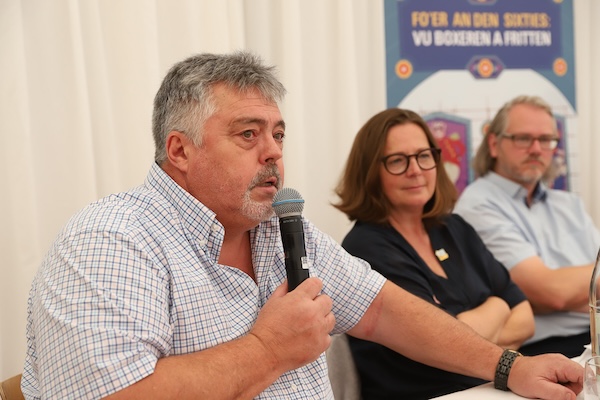
 (L-R) Patrick Weyrich; Veronique Faber; Laurent Schwaller;
Credit: Noelle Schons, C2DH
(L-R) Patrick Weyrich; Veronique Faber; Laurent Schwaller;
Credit: Noelle Schons, C2DH
Contemporary History, Popular Culture and Social Anthropology researcher Véronique Faber recently defended her PhD dissertation titled “Politics at the Fairground: A Transnational History of the Schueberfouer in the Long 1960s” at the University of Luxembourg, sharing key findings and insights about the funfair as a historical and cultural phenomenon.
Her work explored how the fair developed as a site of transnational popular culture, shaped by local governance, administrative decisions and the interests of various stakeholder groups.
It also highlighted how the long 1960s, marked by youth as an emerging consumer group, technological innovation and new forms of popular entertainment, transformed the fairground from a more performative space into one now dominated by mechanical rides, while demonstrating the role of popular culture in shaping this transformation.
Speaking with Chronicle.lu, Véronique Faber explained that the Schueberfouer was selected as a case study as it combines national symbolism with strong transnational structures. She described the fair as a site where “multiple forms of entertainment, different interests and fairground culture intersect”, noting that this sparked her interest in the research.
She said that despite the challenges, doing doctoral research is a long process and writing can feel isolating, adding that support from colleagues at Luxembourg Centre for Contemporary and Digital History (C2DH) made a "significant" difference in staying motivated. She noted that one of the main challenges of a PhD lies in managing one’s own standards, balancing expectations and learning to recognise personal limits.
Sources & Methodology
Véronique Faber explained that the Municipal Archives of the City of Luxembourg (VdL) provided the main sources for her thesis, including annual emplacement lists, correspondence, international communication and, in some cases, police reports. These sources revealed the internal functioning, governance and decision-making processes behind the fair, to the extent that the thesis can also be read as a study of local governance and administrative practices in Luxembourg City.
As major limitations, she identified restrictions imposed by Luxembourg’s archival law, which made it impossible to reconstruct individual trajectories of showpeople and other fairground operators, and the absence of application forms for emplacements, which prevented an analysis of selection and rejection criteria, as well as a full understanding of fairground networks.
At the same time, she highlighted that the available lists generated a large dataset, containing 4,214 entries from 1945 to 1975, the period covered by her thesis, which led her to adopt a new approach using quantitative data to analyse the fairground.
Stakeholders Shaping Funfair
Asked how different stakeholder groups have shaped the Schueberfouer since its origins as a sheep market, Véronique Faber noted that, during the contemporary decades, the fair was shaped by several groups whose interests often intersected and sometimes conflicted. The VdL’s local government played a central role through the Commission de la Foire, the unit responsible for organising the Schueberfouer, which regulated emplacement decisions, coordinated the overall layout of the fair and mediated between municipal priorities and local and national regulations, with its secretaries, first Pierre Weyrich and later Pierre Capesius, acting as cultural mediators by maintaining contacts with showpeople in Luxembourg and abroad, managing emplacements and visiting other fairs, including in Munich, Germany to follow developments and identify new attractions.
She added that showpeople played a key role in shaping the fair through “their professional associations and the continuous introduction of new attractions and technologies”. Their associations advocated for improved working conditions and, from the mid-1970s, engaged in cooperation at European level. Luxembourgish operators maintained high retention rates and a long-term presence, while Belgian and French showpeople relied on strong touring networks. German showpeople were only permitted to return in 1951.
Concessionaires and itinerant merchants were also part of the fairground operators, she said, noting that local businesses often came into conflict with itinerant traders “over which products could be sold at the fair”. One example involved the sale of pressure cookers promoted through live demonstrations, which led to complaints from local retailers and contributed to stricter rules for itinerant traders.
She highlighted that visitors were key stakeholders, as their presence gave the fair its legitimacy, noting that while no attendance data exists, poster campaigns show that it had a high transregional reach.
Evolution of Schueberfouer
Invited to comment on the main changes in the Schueberfouer since its first edition in 1340, Véronique Faber explained: “Funfairs change continuously, with some developments happening slowly and others very quickly.” Originally established as a regional annual market, the Schueberfouer developed into a funfair in the mid-19th century with the introduction of mechanical rides, followed by variety show booths.
She noted that these remained part of the fair until the mid-1990s, although their prominence had already declined after the First World War. In the 1960s, technological advances in attractions accelerated with hydraulics and pneumatics, while societal changes also played a role. Young people gathered around autoscooters, where rock ‘n’ roll and later pop music were played. While youth culture was not new, she added that young people were now recognised as a consumer group with spending power.
'Schobermesse' in US
Referring to the fact that Luxembourg emigrants brought their cultural heritage to the United States (US), Véronique Faber noted that the Chicago "Schobermesse" parade has been organised since 1904 by Section 3 of the Luxembourg Brotherhood of America in the north of Chicago. She explained that it was conceived as a replica of the Luxembourg fair, featuring popular games and traditional food, and initially included an official parade.
She added that voluntary engagement and participation declined in the 1960s, as the link to the Luxembourg Schueberfouer became less present among younger generations, leading instead to the organisation of a national day celebration. After a later revival, today the event continues in a more informal format as a picnic bringing together Luxembourg descendants and their friends.
She explained that her thesis analyses the Schueberfouer as a transnational site of popular culture shaped by sometimes divergent interests and negotiations between different stakeholders. She explained that her research focuses on “contemporary history” and “popular culture”, viewing the Schueberfouer as a “dynamic economic space shaped by negotiation and change”. She added that approaching it as a cultural heritage can obscure this perspective, as such frameworks often emphasise “continuity, nostalgia and symbolic value”.
Popular Culture & Cultural Heritage
Véronique Faber explained that the terms “contemporary history” and “popular culture” best reflect her research approach, describing Schueberfouer “as a transnational site of popular culture shaped by sometimes divergent interests and negotiations between different stakeholders”.
She added that placing the fair under the term “cultural heritage” could obscure its role as a “dynamic economic space”, with heritage frameworks often emphasising “continuity, nostalgia and symbolic value rather than change, politics and negotiation”. She noted, however, that this does not mean the fair cannot also be recognised as cultural heritage, as it is included on Luxembourg’s national list of UNESCO intangible cultural heritage.
Looking ahead, Véronique Faber said her research is expected to result in a book within the next year, along with further articles.