 Credit: SES
On Tuesday 24 March 2026, SES, a Luxembourgish space solutions company, announced plans to deploy meoSphere, a “next-generation” medium Earth orbit (MEO) satellite network targeted for operation by 2030 and aimed at significantly increasing its MEO network capacity.
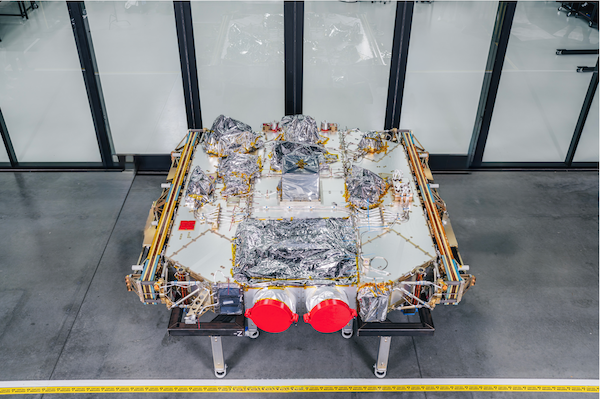
According to SES, the programme will begin with a collaboration with K2 Space, combining SES’s software-defined payloads, developed and manufactured in Luxembourg, with an initial 28 high-power satellite platforms. This first phase is expected to enhance control over supply chains, reduce production timelines and support future scalability.
SES said meoSphere is designed to boost global broadband capacity, increase data speeds and reduce terminal size and costs. The company attributed these “step-change” improvements to advances in payload and terminal technologies, software-defined networking and 5G non-terrestrial network (5G NTN) standards, as well as MEO’s ability to provide low latency and flexible capacity allocation.
The network, which will orbit at approximately 8,000 km above Earth, is also intended to support a range of applications, including government, mobility and telecommunications services. SES added that meoSphere will be compatible with Europe’s IRIS2 programme and will be capable of integrating with sovereign networks.
Beyond broadband connectivity, SES noted that the system could serve as a “backbone network in space”, enabling data exchange between satellite constellations across different orbits and supporting the wider space economy.
“Space is the invisible backbone of the global data economy and national security,” said Adel Al-Saleh, CEO of SES. “Together with K2 Space and other space partners, we’re building meoSphere as essential infrastructure, constructed faster, designed to handle massive data demands globally, and built to support the secure, resilient sovereign networks that our global government allies depend on.”
“The meoSphere partnership with SES is a clear validation of K2’s mission to build the highest power satellites on orbit to realize our partners’ and customers’ ambitions in space,” said Karan Kunjur, Co-Founder and CEO of K2 Space. “We’re incredibly proud to partner in this effort with SES, a longstanding and forward-leaning space industry leader who shares our commitment to building new, efficient space architectures at speed and scale.”
Over the next three years, SES plans to launch a series of MEO “pathfinder” missions with K2 Space to test and validate satellite components and operational concepts ahead of full-scale deployment.
The company noted that the initiative is included in its capital expenditure plans for 2026 and aligns with its policy of disciplined investment, including a mix of commercial and public-private approaches. SES also intends to maintain a dual transatlantic supply chain to improve resilience.
According to SES, meoSphere is designed for applications requiring high levels of reliability, including secure communications for government and defence customers. The network’s architecture is expected to support sovereign operations, including the use of dedicated waveforms and “military Ka-Band” spectrum.
It is also designed for customers whose operations require highly reliable connectivity, where performance must be guaranteed and service disruptions can have significant consequences.
For government and defence customers, this includes command-and-control communications in contested environments. SES noted that MEO’s orbital geometry offers inherent resilience, with a smaller number of widely spaced satellites presenting a different threat profile compared to dense low Earth orbit constellations. The network’s architecture is also expected to allow sovereign customers to operate their own waveforms and modems, including in the “military Ka-Band” spectrum, while optical inter-satellite links (OISLs) ensure secure data routing.
For aviation and maritime users, SES said meoSphere will deliver “fiber-equivalent” throughput to support passenger connectivity, crew communications and operational systems, including across ocean routes. The system’s combination of high throughput and low latency is designed to perform at scale, with a flexible architecture enabling multi-orbit solutions combining MEO with LEO and GEO.
For telecommunications operators and enterprises, meoSphere is expected to provide a high-performance connectivity layer based on 5G-NTN standards, supporting extended network reach and path diversity.