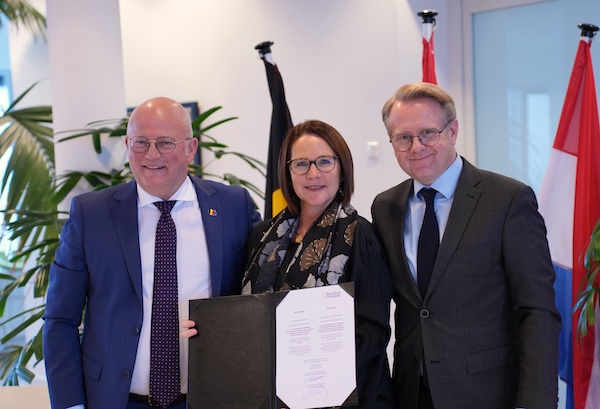
 (L-R) Jean-Luc Crucke, Belgian Minister for Mobility, Climate and Environmental Transition; Yuriko Backes, Luxembourg’s Minister for Mobility and Public Works; Robert Tieman, Dutch Minister for Infrastructure and Water Management;
Credit: MMTP
(L-R) Jean-Luc Crucke, Belgian Minister for Mobility, Climate and Environmental Transition; Yuriko Backes, Luxembourg’s Minister for Mobility and Public Works; Robert Tieman, Dutch Minister for Infrastructure and Water Management;
Credit: MMTP
On Monday 8 December 2025, Luxembourg, Belgium and the Netherlands signed a Benelux recommendation to accelerate the transition towards zero-CO₂ aviation, marking a significant step in long-term cross-border cooperation under the Luxembourg Presidency.
The recommendation was signed by Luxembourg’s Minister for Mobility and Public Works, Yuriko Backes, Dutch Minister for Infrastructure and Water Management, Robert Tieman, and Belgian Minister for Mobility, Climate and Environmental Transition, Jean-Luc Crucke, and aims to support innovations such as electric and hybrid aircraft, hydrogen propulsion and sustainable aviation fuels, the ministries noted.
The cooperation framework places a particular emphasis on technological innovation, including electric and hybrid aircraft, hydrogen propulsion and sustainable aviation fuels. Regional airports are also expected to play a key role, with preparations underway to accommodate these next-generation aircraft and position the Benelux as an early mover in Europe.
The recommendation sets out several strategic measures to support this transition, including joint studies on CO₂-reduction potential, air-quality and noise impacts, and related economic opportunities. It also foresees a Benelux roadmap to align policies and investment priorities, the launch of cross-border test flights and associated infrastructure, and enhanced exchanges of data, expertise and best practices. Cooperation with airport authorities, airlines and European partners, notably the Alliance for Zero-Emission Aviation (AZEA), will be strengthened as part of this effort.
This cooperation aligns with wider European initiatives, including ReFuelEU Aviation, and underscores the important role of regional airports in the transition to cleaner aviation. North Rhine-Westphalia may also join the initiative, which would further strengthen its cross-border dimension; the German Land has already committed to hosting an event on sustainable aviation in Rhineland-Palatinate in 2026.
Minister Backes stated: “Together, we express our ambitious commitment to supporting the development and integration of low-carbon technologies in order to jointly realise solid prospects for environmentally friendly air transport. This commitment now lies at the heart of our pioneering cooperation and marks another major step in strengthening our partnership. With this initiative, we fully assume our strategic leadership within the European Union.” She added: “It is also part of the European ‘e-SAF Early Movers’ coalition initiative to accelerate the adoption of sustainable aviation fuels, for which I signed a declaration of intent on 4 December on the sidelines of the Transport Council in the presence of Commissioner Apostolos Tzitzikostas.”
Dutch Minister Tieman said: “The energy transition in the aviation sector represents a major challenge that requires technological innovation and ambitious policies. This is only possible if we work together. We have a long and fruitful history with the Benelux Union. I am convinced that we can also take significant steps together to achieve and accelerate this transition in aviation.”
Belgian Minister Crucke, responsible for sustainable development, commented: “With this proactive approach, formalised by the signing of this recommendation, Belgium is actively committing to reducing the aviation sector’s carbon footprint. Within the Benelux, we also reaffirm our position as a European leader in the transition towards decarbonised air transport.” He added: “Together, we are creating the conditions for our companies to innovate, for our regional airports to strengthen, and for the aviation-related economy to gain in competitiveness and sustainability. Today, the Benelux demonstrates that climate ambition can be a driver of development and prosperity, and all initiatives supporting the transition must be encouraged.”
Benelux Deputy Secretary-General Jean-Claude Meyer concluded: “Aviation must become sustainable, innovative and more climate-compatible in the future. We hope that this recommendation will create new opportunities for small regional airports by strengthening their role in connectivity, innovation and local economic development.”