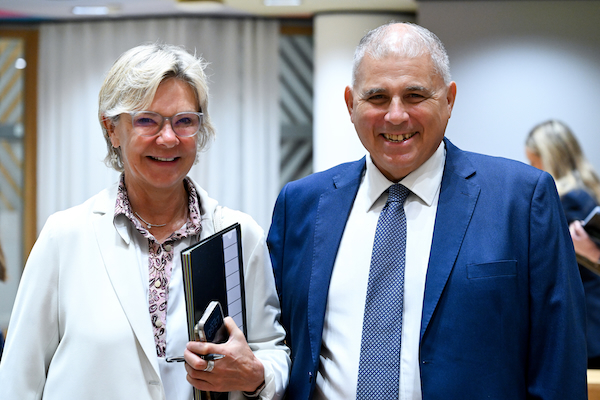
 (L-R) Martine Hansen, Luxembourg Minister of Agriculture, Food and Viticulture; Minister for Agriculture, Fisheries and Animal Rights for Malta;
Credit: European Union
(L-R) Martine Hansen, Luxembourg Minister of Agriculture, Food and Viticulture; Minister for Agriculture, Fisheries and Animal Rights for Malta;
Credit: European Union
On Monday 28 September 2026, Luxembourg’s Minister of Agriculture, Food and Viticulture, Martine Hansen, took part in the meeting of the European Union’s Agriculture and Fisheries Council in Brussels.
According to the Ministry of Agriculture, Food and Viticulture, at the heart of the discussions was the framework for the Common Agricultural Policy (CAP) after 2027.
Minister Hansen highlighted the most important priorities for Luxembourg agriculture: “The most important issue remains the targeting of aid to farmers. The sliding scale mechanism should remain optional because, in Luxembourg, it primarily penalises young farmers who establish themselves on a full-time basis. And if a sliding scale system and capping is to be maintained, the thresholds for triggering it will need to be raised, and the additional payment granted to young farmers should be excluded from this mechanism. The specific situation of farms jointly managed by several families will also need to be taken into account.”
According to the ministry, regarding the definition of an active farmer, Minister Hansen wishes to maintain the current system, which is known and accepted by Luxembourg’s agricultural sector. Additionally, the minister warned that a transition period towards the new CAP is necessary so that farmers can prepare for the 2027–2028 campaign with confidence.
The ministers discussed measures under the recent Action Plan on Fertilisers, which aims to support farmers in the face of rising fertiliser costs and reduce Europe’s dependence on imports. In this context, Minister Hansen proposed simplifying the use of digestates resulting from biogas production, encouraging sustainable practices, investing in the development of alternative and low-carbon fertilisers, and evaluating the Nitrates Directive. At the same time, the minister called for strategic fertiliser reserves to be established at European level, particularly through joint procurement procedures.
Agricultural Markets Under Pressure
Moreover, the ministers discussed the situation on agricultural markets against a backdrop of heightened geopolitical tensions, which continue to drive up fertiliser and fuel prices. The gap between the prices paid to producers and production costs is widening, and the outlook remains gloomy.
Minister Hansen called for a new, more flexible European framework for State aid and supported the idea of a European alliance aimed at addressing gaps in insurance coverage in the agricultural sector.