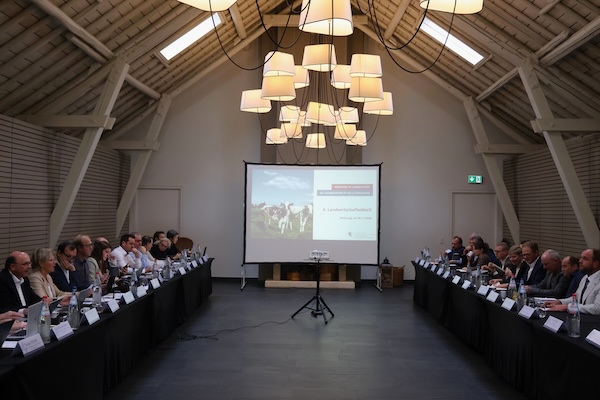
 Participants of the Landwirtschaftsdësch (Agricultural Round Table) in Wickrange;
Credit: MA
On Monday 9 November 2026, Luxembourg’s Ministry of Agriculture, Food and Viticulture issued a report on the participation of Minister of Agriculture, Food and Viticulture, Martine Hansen, who met with representatives of the agricultural sector in Wickrange as part of the Landwirtschaftsdësch (Agricultural Round Table).
According to the ministry, while negotiations at European level on the Common Agricultural Policy (CAP) for the period after 2027 are continuing, the preparation of the next Luxembourg Agricultural Law was at the centre of discussions at national level.
This consultation continues the dialogue already established with the agricultural sector. It has two objectives: firstly, to inform the sector about the current state of EU negotiations on the CAP; and secondly, to review existing support schemes, identify those that have proven successful and consider the adjustments needed to better support farmers.
Representatives of the agricultural sector focused on one central question: how can support measures be adapted to the needs of farms, within the limits of the available budget, while providing farmers with a stable and predictable framework?
A European framework that allows continuity to be maintained
The meeting opened with a review of the outcomes of the Agriculture and Fisheries Council meeting held on 26 October 2026.
The partial general approach adopted by European ministers on the CAP after 2027 provides Member States with sufficient flexibility to adapt support payments to the realities of their agricultural sectors.
One particularly important issue for Luxembourg concerns the definition of an active farmer. The compromise makes it possible to largely retain the definition currently contained in the Agricultural Law. This ensures continuity in directing financial support towards farmers whose main activity is agricultural production.
During the Landwirtschaftsdësch, an agreement was reached that the conditions to be met should henceforth focus on the head of the farming business. Strengthening support for young farmers is also among the important advances.
However, European negotiations are still ongoing. The text must still be adopted by the European Parliament, while financial matters, particularly the gradual reduction and capping of support payments, remain linked to discussions on the next Multiannual Financial Framework.
Developing support measures based on practical experience
The ministry detailed that preparation of the next Agricultural Law is based on an assessment of existing measures: which schemes have worked well, which have encountered difficulties, and where would more targeted support be beneficial?
The objective is to retain effective instruments and improve those that do not adequately meet the needs of the agricultural sector.
Discussions focused in particular on income support and its redistributive component, with a view to examining how best to support farms that need assistance most.
The various options must be assessed in terms of their impact on farms and the budgetary resources available. It was therefore agreed to increase the flat-rate payment for young farmers.
"Our farmers are going through a difficult period. They need predictability and a solid legislative framework on which they can build their plans. We want evolution, not revolution. We are preparing this next Agricultural Law together with the sector, drawing on its experience and needs," emphasised Martine Hansen.
Better targeting support for different types of agricultural production
Coupled support payments formed another part of the discussions, with a review of support for suckler cows, meat sheep, legumes, fruit and vegetables.
The challenge is to take better account of the specific characteristics of different types of production and target support where it can contribute to maintaining or developing agricultural production.
Regarding support for suckler cows, several requests from the sector have been taken into consideration, while administrative procedures will also be simplified.
The possible introduction of a support payment for meat sheep will be examined in greater detail at the next Landwirtschaftsdësch.
As developing legume cultivation as part of a strategy promoting plant-based proteins is a European and national priority, the support amounts for the different eligible crops will be increased.
With regard to domestic fruit and vegetable production, discussions focused on adjusting support payments according to the type of crop, particularly to better reflect their respective labour requirements.
The objective is to create favourable conditions for the development of these types of production in Luxembourg.
Supporting investment and the next generation of farmers
The Landwirtschaftsdësch also provided an opportunity to examine investment support and ways of better targeting financial assistance.
Discussions covered farm adaptation, animal welfare, emissions reduction and the specific needs of different agricultural sectors.
Generational renewal remains a priority for the next Agricultural Law.
Support for young farmers will be maintained, both to facilitate their establishment in the profession and to help them with their investments.
Discussions therefore addressed the start-up grant, the eligibility conditions and the recognition of agricultural training.
The aim is to provide young people with sufficiently secure prospects to encourage them to take over farms and commit to agriculture as a long-term profession.
Their establishment in the sector is essential for the future of Luxembourg agriculture.
Further discussions in December in Senningen
The ministry announced that discussions will continue on Wednesday 2 December 2026 in Senningen, and this second meeting will focus primarily on future agri-environmental and climate measures.
The aim will be to examine the lessons learned from current programmes and consider adjustments that would allow environmental effectiveness to be reconciled with the practical realities of agricultural work.
Dialogue with the agricultural profession will remain central to this process, with the aim of developing a new Agricultural Law that meets the needs of the sector and provides farmers with sustainable long-term prospects.