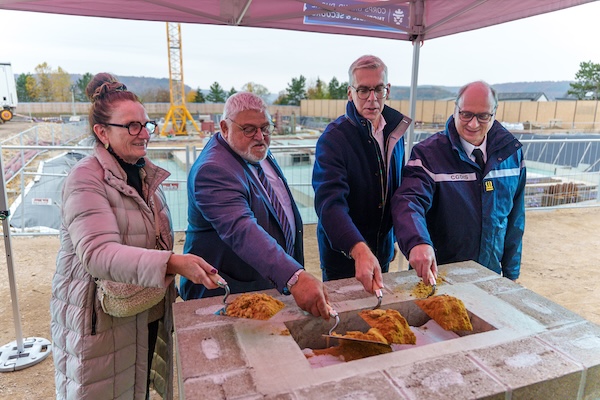
 (L-R) Maryse Fisch, Directorate General for Civil Security; Michel Malherbe, Mayor of the Municipality of Mersch; Léon Gloden, Luxembourg Minister for Home Affairs; Paul Schroeder, Director General of the CGDIS;
Credit: CGDIS
On Tuesday 10 November 2026, the Grand Ducal Fire and Rescue Corps (CGDIS) officially launched construction of its future Logistics and Technical Support Centre (Centre d’appui logistique et technique – CALT) with a foundation stone-laying ceremony in Mersch.
The ceremony welcomed Luxembourg’s Minister for Home Affairs, Léon Gloden; the Director General of the CGDIS, Paul Schroeder; the Mayor of the Municipality of Mersch, Michel Malherbe; and the project’s partners.
According to the CGDIS, the CALT is a strategic facility designed to provide logistical and technical support for emergency response operations nationwide. Located at the Mierscherbierg site, the CALT addresses needs identified as part of the 2018 emergency services reform, as well as growing requirements in terms of crisis preparedness and national resilience. Through the construction of this facility, the CGDIS is equipping itself with the resources needed to support the long-term development of its missions in the service of the population.
The project represents an investment of €110 million, jointly financed by the European Investment Bank (EIB) and Spuerkeess, each contributing €55 million. It is the first-ever public project of this kind to be carried out in Luxembourg in collaboration with the EIB.
The CGDIS said that once completed, the new centre will serve as its logistical and technical hub. It will bring together vehicle and equipment maintenance, a state-of-the-art logistics centre and the administrative services of the Directorate of Logistical Resources on a single site. This centralisation aims to improve operational efficiency and national resilience.
Minister Gloden said: "Strengthening our country's resilience means anticipating tomorrow's challenges. With this new facility in Mersch, we are enabling the CGDIS to ensure the safety and protection of the population under all circumstances."
The CALT
Designed in accordance with Nearly Zero Energy Building (NZEB) standards, the building will incorporate modern technological and energy solutions, including a robotic stock management system, geothermal installations and a large-scale photovoltaic installation.
With 18,035 m² of usable floor space and an organisation divided into five functional zones, the CALT will provide sustainable, functional infrastructure adapted to the current and future needs of the emergency services.
As a symbolic highlight of the ceremony, a time capsule was placed in the foundations of the future building. Among other items, it contains a certificate signed by those in attendance.