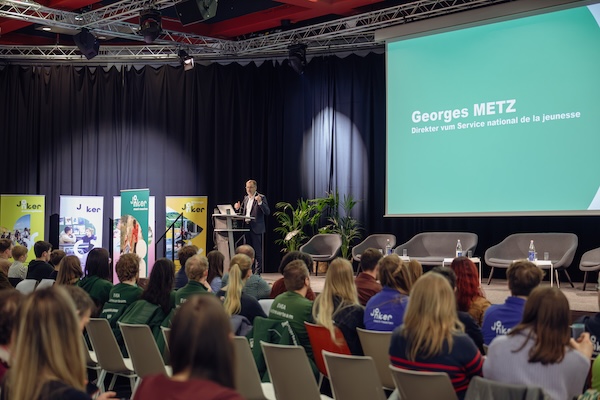
 Credit: SNJ / Mathilde Magne
On Friday 13 November 2026, the National Youth Service (Service national de la jeunesse - SNJ) reported on the third edition of the Youth Sector Conference, held on Thursday 12 November 2026 at Forum Geesseknäppchen in Luxembourg-Merl.
According to the SNJ, around 200 youth sector professionals and municipal representatives gathered to discuss the role of municipalities in implementing youth policy at local level.
A series of workshops gave professionals working in the field, managers of youth services and local decision-makers an overview of good practices implemented in Luxembourg municipalities to involve young people more actively in local community life. During these workshops, moderated by municipal representatives and youth sector professionals, participants discussed opportunities, challenges and possible actions to support young people at municipal and regional level.
Gilles Dhamen, First Adviser at Luxembourg's Ministry of Education, Children and Youth, presented the ambitions of the Jugendpakt 2026–2030 and, more specifically, the role of municipalities in its implementation.
Georges Metz, Director of the SNJ, addressed the conditions that make a municipality welcoming to young people, as well as the support options offered by the SNJ.
Researcher Rosa Lisa Iannone presented the initial findings of a study conducted by the University of Luxembourg on how young people perceive their municipality and the factors that contribute to making it welcoming in their eyes.
During a round-table discussion, young people and municipal decision-makers exchanged views on the conditions that make a municipality a place where young people feel they belong and can thrive. According to the SNJ, the discussion aimed to inform municipal policies through young people's lived experiences.
The discussions highlighted that meeting young people's expectations does not always require substantial resources. Simple measures, such as facilitating access to existing municipal facilities, can already make a difference.
Sara Thill of Landjugend emphasised: "We need to make what already exists more attractive, for example by allowing young people to use a sports hall when no club is occupying it. It is also about trusting them and giving them responsibility for the use of these spaces."
The discussions also highlighted that a municipality welcoming to young people is, above all, one that is accessible to its residents, where everyone can easily contact municipal officials and make their concerns heard.
According to the SNJ, this edition formed part of the Youth Pact 2026-2030, which defines youth policy priorities and gives municipalities an important role in implementing its 48 measures.