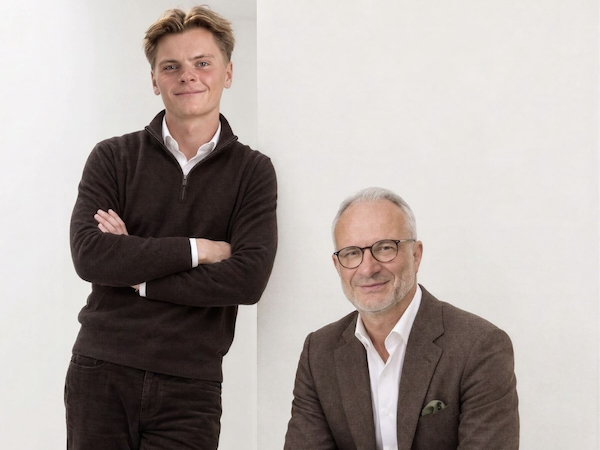
 (L-R) Thibault Sablon and Patrick Lesage, co-founders of Luxembourg-based artificial intelligence (AI) agency naia;
Credit: naia
Small to medium enterprises in Luxembourg can now take advantage of naia, a new Luxembourg-based artificial intelligence (AI) agency that helps Luxembourg SMEs AI to “work for their teams, not instead of them”.
Co-founded by Patrick Lesage and Thibault Sablon, naia is intended to assist businesses as the transition of AI accelerates. In a press release, the team behind naia noted that, according to STATEC, more than 90% of Luxembourg workers could see their jobs change with artificial intelligence but stressed that “rather than jobs disappearing, what lies ahead is a profound transformation of tasks and skills”.
“AI is now accessible to everyone, but there’s a big step between trying out a tool and putting it to good use in a business. That move into practice is where many SMEs get stuck,” said Thibault Sablon, co-founder of naia.
Transforming work, not eliminating it
According to the agency, in most sectors AI is expected to augment work rather than replace it, with administrative tasks the most likely to be automated. Recent European studies also showed that companies making greater use of AI are more productive, invest more and do not cut jobs.
Noting Luxembourg’s strengths - where 33.6% of companies with ten or more employees use AI, compared with 20% across the EU, ranking the country fifth among the 27 Member States - the agency observed that inside companies, turning intentions into action remains difficult, even for the largest, with only 30% of business leaders feeling they are moving at the right pace, compared with 66% worldwide, and only half considered their teams ready.
Support designed for SMEs
Before launching, the two co-founders reviewed more than 150 players in the sector, from independent consultants to large consulting groups. Their conclusion: small businesses, which make up the bulk of Luxembourg’s economy, rarely find support suited to their resources and constraints. For Patrick Lesage, the obstacle is less technical than strategic: “Business leaders do not need more tools; they need perspective. Knowing what to do, why and in what order.”
According to the agency, training is at the heart of their approach. “My job is to make intimidating technologies simple. The question we keep asking ourselves is: is this useful and can we make it simpler?” explained Thibault Sablon.
“Thibault knows the tools; I know businesses and the people who run them. We teamed up because neither of us, on our own, could meet the real need of SMEs: knowing what AI can do, and above all what it should do for them,” added Patrick Lesage.
Further information about the agency can be found at naia.lu.