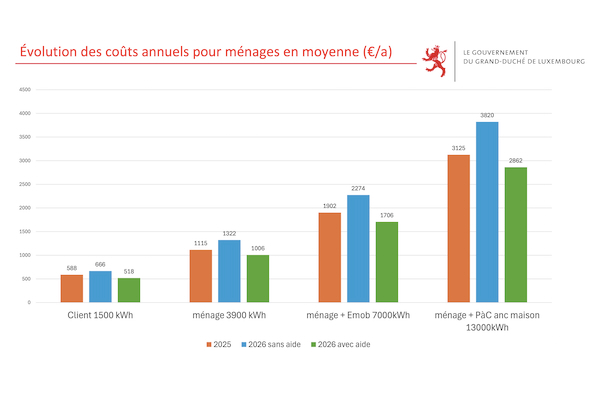
 Changes in average annual electricty costs for households (€/year);
Credit: MECO
Changes in average annual electricty costs for households (€/year);
Credit: MECO
On Tuesday 2 December 2025, Luxembourg Minister for the Economy, SMEs, Energy and Tourism, Lex Delles, outlined the arrangements for the new State contribution towards electricity network charges.
Minister Delles also provided an update on national progress in renewable energy production, with the Government stating three objectives: to ensure affordable electricity; strengthen supply security; and increase national renewable energy capacities.
The Ministry for the Economy, SMEs, Energy and Tourism remarked that affordable electricity is essential for both businesses and household purchasing power. At the same time, modernising and digitalising the network remains necessary to guarantee a safe and sustainable supply. That is why the Government is investing directly and from Thursday 1 January 2026 for a period of at least three years, the State will cover a portion of network charges. In total, €150 million will be invested for the year 2026. This measure applies automatically to all households and businesses with no action required.
Minister Delles stated: “Thanks to the State contribution towards network charges, I affirm my commitment to affordable electricity. This is essential for household purchasing power and the competitiveness of our businesses. This measure is intended to last for three years, providing stability and visibility for both households and businesses.”
The ministry also announced that from 2026 the development of renewable energy will no longer be financed through a levy on individual electricity customers. The contribution to the compensation mechanism will now be covered directly by the State budget. This contribution is in addition to that for network charges.
According to the ministry, without aid, the electricity price for a typical household with a consumption of 3,900 kWh per year would reach 33.9 ct€/kWh on average in 2026. Thanks to the contribution towards network charges (-3.8 ct€/kWh on average) and the State’s intervention in the compensation mechanism in 2026 (-3.6 ct€/kWh on average), the integrated price for a typical household decreases by a total of 7.4 ct€/kWh. The price will therefore be approximately 25.8 ct€/kWh on average for a typical household consuming 3,900 kWh. Without the aid measures, annual electricity costs for a household with a consumption of 3,900 kWh per year would amount to €1,322. Thanks to the aid, these costs are reduced to €1,006 per year.
The Government is also strengthening its commitment to national renewable energy development, produced locally with citizen participation and said this constitutes a key pillar of the national strategy for energy supply security. Through the “Einfach, Séier, Erneierbar” (“Simple, Fast, Renewable”) process, a series of concrete measures to simplify procedures has been implemented to accelerate wind and solar projects in the areas where they make the most sense and have the least impact on humans and nature: along motorways, or on impervious surfaces such as roofs and car parks.
The ministry noted the following advances in renewable energy made by Luxembourg over the last two years:
Photovoltaics:
• In 2024, Luxembourg saw a record year for new photovoltaic capacity installation: more than 150 MW added and over 8,000 new installations connected to the grid (theoretically covering the consumption of 33,750 households).
• 2025 is expected, like 2024, to be another record year for photovoltaics in Luxembourg. By the end of November 2025, 150 MW had already been connected to the grid (theoretically covering 33,750 households), representing around 8,300 new installations. The total installed capacity now reaches nearly 700 MW, distributed over more than 30,000 installations across the country (theoretically covering 137,500 households).
Wind Power:
• In 2024, newly installed capacity reached 7.2 MW, corresponding to two new installations.
• In 2025, activity increased with an additional 16.9 MW and four new installations, of which three may still be connected to the grid by the end of the year.
• Total installed capacity now reaches 230 MW, spread over 74 installations (theoretically covering 125,000 households).
Renewable Energy Production:
• National renewable energy production significantly exceeds residential electricity consumption: more than one and a half times household consumption (residential customer electricity consumption is approximately 1 TWh, while production reaches 1.6 TWh).
Lex Delles stated: “The national progress in renewable energy production, exceeding one and a half times household consumption, shows that we are moving decisively towards a responsible, forward-looking energy transition. But we will not stop there: we will continue on this path through new photovoltaic tenders, wind power development, and the planning of heating networks, to further strengthen our energy independence, support the competitiveness of our businesses, and protect citizens’ purchasing power.”