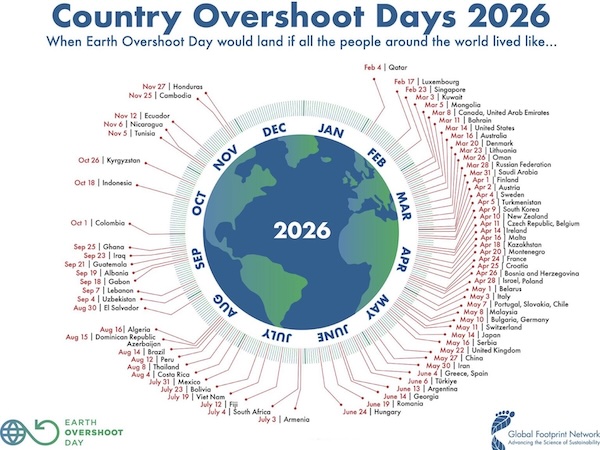
 Global Footprint Network (GFN) country rankings for Overshoot Day 2026;
Credit: Global Footprint Network
Global Footprint Network (GFN) country rankings for Overshoot Day 2026;
Credit: Global Footprint Network
On Tuesday 17 February 2026, Luxembourg yet again had the dubious honour of being the first European country to reach its “Overshoot Day”.
The origins of Overshoot Day stretch back to 2006 when the Global Footprint Network (GFN), an international research organisation focused on ecological sustainability, first published data to illustrate at what point in a given year humanity’s consumption of natural resources exceeded what the Earth can regenerate in that same year.
In 2019, GFN introduced rankings for each country, breaking down what was originally a global measurement into a top-ten list of the worst culprits. Since then, Luxembourg has never dropped out of the top three, regularly achieving the second spot behind perennial winner Qatar.
A number of factors are included in GFN’s calculations, including the amount of biologically productive land and water area a population requires to produce the resources it consumes and to absorb the waste it generates. The calculation factors in each country’s carbon footprint (the forest area required to sequester CO₂ emissions), arable land (for food, fibre and oil), grazing land (for meat and dairy production), forest-derived products (timber, paper), fishing zones (for seafood) and developed land (infrastructure footprint). Biocapacity is also factored in, measuring the capacity of ecosystems to regenerate the resources a population consumes and its ability to absorb the waste generated.
According to Votum Klima, a civil-society climate coalition in Luxembourg, if the entire world population lived like Luxembourg residents, 6.88 planet Earths would be needed to sustain that lifestyle, which is beyond the already unsustainable European average of 3.14 Earths.
According to a study by the Higher Council for Sustainable Development (CSDD), published in 2023 and conducted in collaboration with the Luxembourg Institute of Science and Technology (LIST), the most impactful sectors which contribute to Luxembourg’s ranking include: fuel tourism; food; manufactured goods; household consumption; construction; the services industry and air freight.
When aligned next to many of the government’s environmental policies and ambitions, a distinct picture emerges: to be seen to being doing the right things as long as they do not impact the fiscal benefits of continuing to do the wrong things.
As an example, in the public sector, let us take the government’s subsidies for electric vehicles. Excellent news for the country’s energy transition ambitions but more than a little at odds to the attitude of successive governments who have happily accepted significant tax revenue from fuel tourism (accounting for 4.3 % of the country’s total expected tax revenues in 2023, according to byteseu.com). In other words, we will help you have that nice new electric car as long as you live in Luxembourg but we will fund those subsidies from the revenue generated from fossil fuel sales to foreigners through lower fuel excise duties and VAT relative to Belgium, France and Germany (VAT of 17% versus 21%, 20% and 19% respectively). Should these excise and taxes not be increasing in line with the push to transition away from fossil fuels?
In the private sector, there is the curious case of CargoLux, an undeniable success story for the country. According to Cargolux themselves it is Europe’s “number one pure all-cargo airline”. Yet despite the fanfare surrounding the construction of a new fuel port at Luxembourg airport as part of the adaptability of the aviation sector’s move towards greater use of sustainable aviation fuels (SAF), the Findel-based company still uses 30 747 freighter jets to maintain its lofty status. Those 747s in use by Cargolux have a higher fuel burn rate than newer models from Boeing, Airbus and other air freighter manufacturers. Yet, despite its publicised plans to upgrade its ageing fleet of Boeing 747s, the cargo company recently purchased two additional 747-400 freighter jets from China Airlines and does not expect to replace its full 747 fleet until at least 2040.
The air-freight company is certainly not enamoured by EU legislation requiring it to use an ever increasing blend of aviation fuel containing SAFs (up to 70% by 2050), which costs two to three times the price of existing carbon-based fuel. A transition Cargolux CEO Richard Forson described in 2024 as “an existential threat” to the business’ operations.
Nevertheless, the company has invested in the development of bio fuels with a Norwegian partner, Norsk e-Fuel, part of a drive to move Cargolux to net Carbon Zero status by 2050.
State ownership of Cargolux is presently at around 30%, yet there seems to be very little pressure or appetite for its environmental ambitions to align with Luxembourg’s core national strategy for reducing air pollution and meeting EU limits by 2030.
With air freight traffic projected to increase by 4% annually through to 2043, it seems unlikely that there will be any significant shift in environmental policy for the company, which currently employs around 3,200 people.
Then there is the “people sector”, the one which often seems to want to be seen to be doing the right thing but continues to ignore reality with an ever increasing set of contradictory behaviours. Electric car? Check! Solar panels? Check! Recycling? Check! Excessive meat consumption at nearly 10 kg higher than the EU average? Check! An individual consumerism rate 46% above EU average? Check! Residents who are the most travelled in Europe? Check!
At the most extreme end of Luxembourg’s overconsumption is the startling statistic that the Grand Duchy has the highest density of luxury cars in the world, with approximately one luxury vehicle per thirteen inhabitants. According to Forbes Luxembourg, this is a result of the country’s high salaries and favourable tax conditions, which include no specific high-CO₂ penalty taxes. This is sadly another example of how the affluent are the greatest polluters and consumers, eschewing any form of responsibility for their actions when they are the best placed in society to be more progressive.
While poverty most certainly exists in Luxembourg and individual efforts to improve our consumption levels and our impact on the environment need to be applauded, the country itself is more than wealthy enough to become an ambitious standard bearer for a more environmentally sound future, instead of being ongoing holder of one of Europe’s least auspicious titles.
As the world's second-largest investment fund centre, it is surely time for Luxembourg to take a hard look at how those funds are set up and to rapidly facilitate a move to more ethical and less environmentally detrimental structures. Yes, Luxembourg established the Luxembourg Green Exchange (LGX) in 2016, which along with the LGX Platform provides sustainable finance education, data and assistance services, but almost a decade after its establishment has it truly made a dent in the drive to reorientate capital flows towards a more inclusive and climate-resilient future?
The LGX, along with the government’s well publicised pro-environment initiatives to strengthen forest ecosystems, accelerate vehicle decarbonisation, introduce sustainable event management and its support for a European Renewable Energy Market, should rightly be applauded. However, it seems as if much of the Luxembourg population, successive governments and the private institutions who promote external investment into this country are happy to be seen to be doing something as long as they do not have to recognise the consequences of the damage being done through their other ambitions.
Personally, with Luxembourg continually achieving second place in the Overshoot Day rankings, I do not believe this can even be attributed as a generational issue which will be resolved over time as environmental education and technology improves. I firmly believe it is an institutional issue which touches on the psychology of the country as a whole.
The argument that because Luxembourg is a small country it can only do so much no longer carries any weight in the face of the environmental disasters unfolding today, especially after another year where the Grand Duchy again tops Europe’s Overshoot Day chart.
For all of the positive “Letz do” aspiration we see everywhere, maybe it’s time the country applied some “Letz don’t” labelling to our most damaging yet most ignored practices.