 Credit: Steven Miller
Christmas as we celebrate it today in the westernised world is a very different occasion to the one which was observed by our ancestors.
Over the centuries, Christmas has evolved from its beginnings as a religious festival celebrating the birth of Jesus Christ - merging with old European winter festivals such as the Roman Saturnalia and Germanic Yule - to eventually become the mostly social occasion celebrated today.
Many of the modern traditions associated with Christmas, such as Christmas trees, ornaments, tinsel and wreaths, originated in 16th- and 17th-century Germany, while Advent calendars emerged in the 19th century as a way to mark the countdown to Christmas. By the 19th and early 20th centuries, commercial and social customs such as Christmas cards, gift wrapping and decorative lights became popular in Britain and the United States, helping to shape Christmas into a widely celebrated holiday that now blends religious meaning, festive decoration and family-centred gift-giving.
The embodiment of modern Christmas is undeniably the character of Santa Claus. His roots can be traced back to the 4th century and what is now Turkey. Known then as Saint Nicholas, he was a Christian bishop renowned for his generosity, especially toward children and the poor. Folklore describes him secretly leaving gifts for needy families, inspiring the idea of him as a benevolent gift-bringer.
Yet, he was not adorned in the red suit and sporting a thick white beard like he is depicted today. Nor was he based on the North Pole dwelling, reindeer owner with a sleigh packed with gifts for children around the world.
This image of Saint Nicholas was first born out of the tradition of Sinterklaas, which was brought to the US in the 17th century by Dutch settlers. For them, Sinterklaas wore a red bishop’s robe and delivered gifts to children on 5 December, the eve of Saint Nicholas Day. Then, in the early 19th century, an anonymous American writer published the poem “A Visit from St. Nicholas”, in which the saint was described as a jolly, plump, home-visiting figure who rides a sleigh and delivers toys.
From there, Santa was described in various ways, wearing a suit of different colours and exhibiting different personalities - sometimes happy, sometimes stern. It was not until 1931 when The Coca-Cola Companycommissioned illustrator Haddon Sundblom to create a series of advertisements featuring Santa Claus drinking their popular soft drink that we would see him as the red-suited, cheerful, rotund version, that is now essentially canonical.
Other Christmas traditions have followed a similar path in being transformed over the years. Sadly, many have been monetised in a way which encapsulates the capitalist spectacle that Christmas has become for many modern societies.
Travelling back to the 16th century, the origins of the Christmas tree are rooted in Germany (a country responsible for many of the decorative traditions of Christmas), where a tree would be chosen and adorned with nuts and fruits to symbolise life in winter and the season’s religious themes. While the trees would remain mostly the same, the decorations - including tinsel and wreaths - eventually became more ornate, representing a sense of status and wealth and birthing an entire industry, one which Global Growth Insights estimated is currently worth more than €6 billion per annum.
One of the most popular modern symbols of the festive season, the Christmas card, was invented in 1843 by Sir Henry Cole, a British civil servant. Created to make it more convenient for him to message friends, relatives and acquaintances at Christmas - removing the formality of writing numerous letters - he commissioned artist John Callcott Horsley to design the first commercial Christmas card, which depicted a family drinking wine together and included the greeting “A Merry Christmas and a Happy New Year to You.” With the advent of email, messaging apps and social media, along with ever increasing postage costs, Christmas cards could be regarded as niche these days. Yet, according to industry statistic website Gitnux, around 1.3 to 1.6 billion Christmas cards are still sent each year in the US and UK.
Before the early 1900s, gifts were traditionally wrapped in plain paper or fabric. It was not until the Hall Brothers, who established the Hallmark gift card and gift wrap company in the US, created what we commonly now refer to as wrapping paper. Intended to hide the contents of a gift until opened, it created a playful and decorative way to present gifts and seasonally present them. This birthed the use of gift tags, ribbons, boxes and other accoutrements to make one’s gifts stand out from others. Gloabalnewswire estimated that gift wrapping paper alone is a €5 billion per year business.
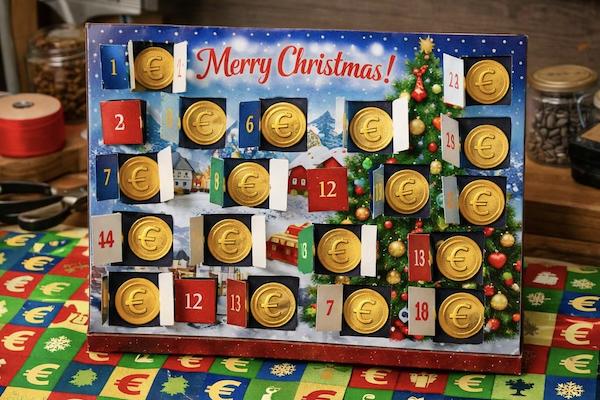
Perhaps the oddest transition from an older Christmas tradition to a modern equivalent is that of the advent calendar. In the mid-19th century, the days of Advent were literally marked with chalk lines used to tally the passing of the days of Christmas period. This developed into the lighting of candles and now exists with the opening of small doors on a box, hiding tiny gifts ordinarily made of chocolate but now extending to a variety of items including everything from whisky miniatures to cosmetics.
All of these changes have been fuelled through a mix of secularisation, increased wealth, a cultural shift from a once traditional lower class religious celebration to one based on a fantastical Dickensian ideology, as well as an increased focus on family, charity and gift-giving.
Ultimately, it has become an industry unto itself, which contributes a considerable proportion of yearly income to industries ranging from manufacturing to hospitality and functioning as an integral part of the growth-driven capitalist model of the modern world. This has, sadly but not surprisingly, resulted in hugely negative environmental impacts from increased air travel, transportation costs and the damage through increased manufacturing and increased waste.
I live in the knowledge that gifts I received as a child some 40 years ago will still be decaying and breaking down in a landfill longer than I will exist. The whims of my parents decision to buy me a plastic toy because of the social pressure to do so at the time may not seem much in isolation but multiplied on a global scale it is part of a legacy which will impact the health and well-being of everyone in the future.
I have not even touched on the mental stress to conform to “Christmas norms”, which seems to me to have become such a fundamental yet overbearing part of the modern Christmas experience. I do not want to be the proverbial Scrooge but surely, if the Christmas experience cannot be enjoyable or memorable without the modern tradition of excess we exhibit today then we have surely lost sight of what Christmas was about, both in the first place and what it evolved into pre-20th century: a festival celebrating life, family, friendship and appreciation.
Christmas has become a seasonal celebration so inescapable it is celebrated by billions around the world despite many of them having no real connection to its religious origins. Given its impact on society, culture and the environment, is now the time to re-evaluate what Christmas is as a celebration and how we choose to celebrate it?
The ongoing celebration of Christmas demonstrates that even deep-rooted traditions evolve. It is surely our responsibility to now recognise that the evolution of this tradition is firstly very much separated from the one observed by our ancestors and secondly that today is the embodiment of much of society’s current ills: over-consumption; unnecessary social pressure; and the support of an environmentally destructive system based on diminishing self-satisfaction.
Maybe this Christmas we should recognise that in one of Christmas’ most celebrated stories - Charles Dickens’ A Christmas Carol - Ebeneezer Scrooge’s idea to gift an enormous bird to the Cratchit family completely missed the point of their ongoing social peril. They did not need a huge game bird to feast on for a single day, they needed a more thoughtful, considered and understanding view of life from those positioned above them – those tossing coins from windows to the people beneath them.
The idea that excess is success and cause for celebration is nothing new. It is certainly old enough to be considered a societally traditional trope. Maybe it is time for that tradition to change too.