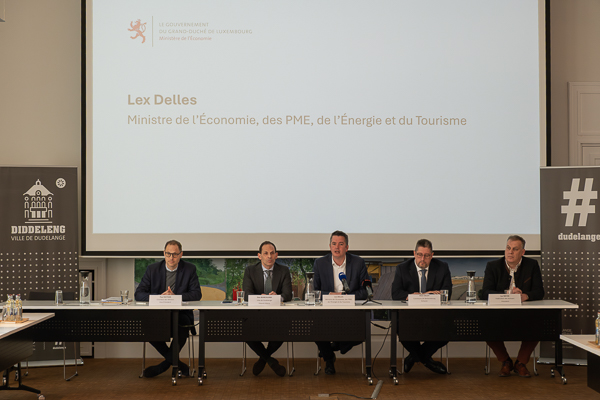
 (L-R) Paul Nathan, Vice-President of the Chamber of Skilled Trades; Dan Biancalana, Mayor of Dudelange; Lex Delles, Minister of the Economy; Alain Gillet, Alderman of the Municipality of Bettembourg; Luc Meyer, President of the Federation of Craftsmen;
Credit: Ali Sahib, Chronicle.lu
(L-R) Paul Nathan, Vice-President of the Chamber of Skilled Trades; Dan Biancalana, Mayor of Dudelange; Lex Delles, Minister of the Economy; Alain Gillet, Alderman of the Municipality of Bettembourg; Luc Meyer, President of the Federation of Craftsmen;
Credit: Ali Sahib, Chronicle.lu
On Thursday 12 March 2026, Luxembourg's Minister of the Economy, SMEs, Energy and Tourism, Lex Delles, presented the future “Handwierkerhaff” craft park project at Dudelange City Hall, which is set to be developed in the “Wolser” economic activity zone on part of the former Liberty Steel site.
The presentation took place in the presence of Dan Biancalana, Member of Parliament and Mayor of the City of Dudelange, Alain Gillet, Alderman of the Municipality of Bettembourg, Paul Nathan, Vice-President of the Chamber of Skilled Trades, and Luc Meyer, President of the Federation of Craftsmen.
In his opening speech, Dan Biancalana said the Handwierkerhaff project represents an important step in strengthening economic activity in the Wolser zone and supporting the city’s development following the crisis in the steel industry. He noted that Dudelange has been diversifying its economic base in recent years across sectors such as industry, logistics, health and innovation. “The Handwierkerhaff will give the craft sector greater visibility and create new opportunities for businesses and local employment,” he said.
Following the bankruptcy of Liberty Liège-Dudelange (LU) SA in November 2024, the Luxembourg State acquired the existing buildings on the former site in March 2026. This acquisition allows the government to rethink the future economic development of the site, located at the heart of the Wolser economic activity zone. Part of the site will be dedicated to the future Handwierkerhaff, while another section, the former Galvalange site, will be reserved for defence-related activities.
The Handwierkerhaff concept was developed in close cooperation with sector representatives, notably the Chamber of Skilled Trades and the Federation of Craftsmen, in order to respond to the concrete needs of craft businesses. The project aims to bring together several companies on the same site, allowing them to share certain infrastructure, strengthen synergies and optimise the use of available space. During the presentation, Minister Delles said the project would help craft businesses settle, grow and develop in a more suitable environment.
The project is set to be implemented in three phases, beginning with the renovation of part of the existing halls, followed by the demolition and reconstruction of the remaining halls. In a first phase, part of the current halls will be renovated to accommodate the first craft businesses. This stage represents an investment of around €10 to €12 million, financed by the State and expected to be amortised over ten to fifteen years through rent paid by companies leasing premises within the Handwierkerhaff.
Minister Delles said the first phase could accommodate around 50 craft businesses and create approximately 180 jobs. In the longer term, once both buildings are completed, the site could host between 3,000 and 3,500 employees.
As part of the long-term development of the site, a first new densified building will be constructed on an area of around 2.5 hectares. The future complex will be 30 metres high and will comprise five floors, three dedicated to craft activities and two to administrative space, for a total usable area of around 80,000 m². Once this new building is completed, the companies located in the renovated section will be transferred there, after which that part will also be demolished and replaced by a second, similar building.
The project also stands out for its densification approach, integrating truck circulation areas directly inside the building in order to reduce the surface area required and optimise the organisation of activities. During the presentation, Minister Delles underlined that the project is designed to make more efficient and intelligent use of land, while also creating modern infrastructure adapted to the needs of the craft sector.
The next steps in the project are scheduled to begin in 2026, when a call for tenders will be launched for remediation works on the existing buildings and for the building permit application related to the transformation of the first hall. Site preparation works are also expected to start during the year.
By the end of 2026, a call for applications will be issued to identify companies interested in settling at the future Handwierkerhaff. Minister Delles added that candidate companies will be assessed by a dedicated committee based on criteria such as the type of activity, the number of jobs created and the compatibility of the project with the economic activity zone. Transformation works on the first hall are planned to begin in 2027, with the first businesses expected to move in when the site gradually becomes operational from 2028.
Alain Gillet also commented on the project: “For the Municipality of Bettembourg, this project represents an important opportunity to strengthen the local economic fabric and support employment. It also illustrates our commitment to reconciling economic development with responsible land management by promoting more efficient land use and limiting land artificialisation.”
Paul Nathan presented data from a survey conducted by the Chamber of Skilled Trades in the first quarter of 2025, which highlighted the demand for new space among craft businesses. According to the results, 114 companies (22%) are currently looking for a new site, representing a total demand of around 68 hectares of space.
Commenting on these findings, Paul Nathan said: “The lack of suitable land and spaces remains one of the main obstacles to the development of our craft enterprises. Given the high demand for space, it is the responsibility of public authorities to provide appropriate infrastructure to support their growth.”