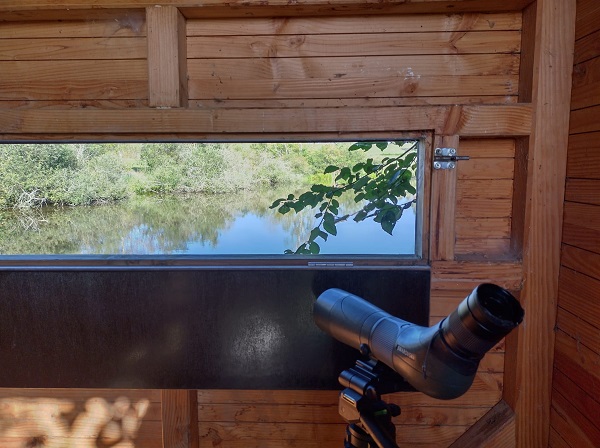
 Credit: Patrick Meurin
In the latest in a series of articles about current conservation issues, experts at natur&ëmwelt, a leading nature conservation NGO in Luxembourg, spoke to Chronicle.lu about the international EuroBirdwatch, why it takes place and what birdwatching is all about.
Natur&ëmwelt volunteer Vanessa Bock helped collect the relevant information from the NGO for this article.
More than 15,000 people across Europe and Central Asia participated in this year's EuroBirdwatch, which took place over the weekend from 30 September to 1 October 2023.
Chronicle.lu: The arrival of autumn means one thing: bird migration. And with it, its annual EuroBirdwatch. To start things off, what is birdwatching?
Natur&ëmwelt: Birdwatching or birding is the observation of birds in their environment. The study of wild birds in their natural habitat, if you will. It is not only considered a recreational activity, but more often, it is also a form of active engagement and participation of members of a community. It is at once an activity, a practice, a study and a science. Over the years, it has become an increasingly important approach of collecting and capturing data about the variety of birds. This is done with the Central Ornithologique Luxembourg’s second approach, of generating useful monitoring information regarding the movements of birds called bird ringing.
Chronicle.lu: There is this saying that birds are an integral part of the health and changes of our ecosystem. How so? And how does birdwatching come into play?
Natur&ëmwelt: Indeed it is. Birds are intricately linked to their environment (as are we), and are sensitive to habitat change. When they are on the decline, their functions that help our environment thrive disappear. Through observations, we get an insight into bird behaviour - what causes them stress and disrupts their rich internal (and of course, external) landscapes.
Chronicle.lu: Does that go hand in hand with bird migration?
Natur&ëmwelt: Yes. Another important indicator of birds being an integral part is their migration patterns. As the birds prepare to seek shelter for the upcoming winter months, they rely on routes where they can refuel and replenish. Due to the arduous distances they undertake, this has consequences on their completion of their journey. By studying it, we are able to adopt specific measures of conservation such as creating artificial nests or expanding natural reserves and wetlands that serve as protected areas.
Chronicle.lu: Speaking of locations, where and when can we birdwatch? What are the best places to birdwatch?
Natur&ëmwelt: As of now, we have twelve wetland zones in Luxembourg, one of the most prominent and largest reed banks being Schlammwiss. Here we can observe and discover reed and marsh warblers as well as blue throats, bearded tits and many other species. Thanks to its open areas, it allows plenty of space - its terrain is filled by forest, meadows and grassland. Other places involve Haff Réimech and the Biodiversum.
Chronicle.lu: Tell us more about EuroBirdwatch?
Natur&ëmwelt: Quite a spectacular event taking place each last weekend of September. The main goal is raising awareness for bird preservation and conservation as well as getting people interested in birds. As you know, being curious is the first step. Everything else follows. The EuroBirdwatch is not only a shared activity, but it actually expands how you see the world: by listening and paying attention to what is out there. How it functions: observations of different birds are noted and counted and the results are later published on the Euro Birdwatch online page: www.eurobirdwatch.eu.
Chronicle.lu: What observations have been made this year?
Natur&ëmwelt: This year, natur&ëmwelt names the most frequently observed species in Luxembourg as follows: the Eurasian chaffinch (117), the Eurasian blackcap (62) and European robin (58). Crossing borders like migratory birds, up to 155 visitors came to observe the fascinating bird migration and to learn more about the importance of wetlands as resting and feeding places on their journey. One of the highlights was the passing of a whinchat at Schlammwiss, Munsbach. The latter has been considered extinct as a breeding bird in Luxembourg since 2002 and could be ringed at the occasion of this event.