 Credit: Klima-Agence
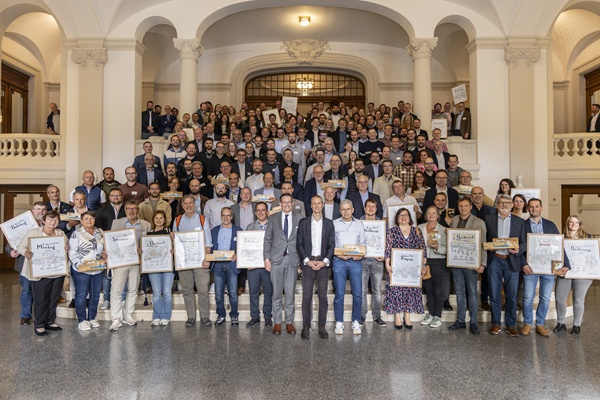
On Friday 8 May 2026, Luxembourg's Klima-Agence held the fourteenth edition of "Klimapakt-Dag" (Climate Pact Day) at Cercle Cité in Luxembourg-Ville.
According to the organisers, the event brought together more than 220 municipal officials, institutional partners and stakeholders committed at local and regional level to accelerating the energy transition and strengthening climate protection.
Klima-Agence noted that municipalities play a vital role, both as drivers of local action and as frontline actors in addressing current challenges, by strengthening territorial resilience and contributing to building a more independent future through concrete initiatives tailored to local realities.
Held in the presence of Luxembourg's Minister of the Environment, Climate and Biodiversity, Serge Wilmes, the event enabled representatives of the municipal sector to learn more about solutions and opportunities for implementing climate change adaptation measures. Faced with the intensifying effects of climate change, adaptation has become an essential complement to mitigation policies.
The Climate Pact, described as a central instrument guiding municipal policy, provides municipalities with a framework for structuring their efforts and prioritising measures in areas such as land-use planning, sustainable mobility and internal municipal organisation. Its objective is to support local authorities in their energy and climate transition.
One of the highlights of the Climate Pact Day was the presentation of Climate Pact certifications to 47 Luxembourg municipalities recently audited for their efforts under the programme.
This year, fourteen municipalities exceeded the 50% threshold, eighteen surpassed the 65% level and fifteen received the international "Gold" certification for achieving more than 75% of the points in their audit.
For the first time, two municipalities - Esch-sur-Alzette and Kopstal - obtained the thematic certification for "Adaptation to Climate Change".
Since the launch of Climate Pact 2.0 in 2021, 97 municipalities have reached at least the first level of certification.
The event on Friday also marked the conclusion of the second edition of the Solar Challenge competition, which aims to encourage municipalities, citizens and businesses to further develop solar energy in Luxembourg. The initiative specifically aims to promote the installation of photovoltaic panels and to recognise the efforts of municipalities and residents.
A total of 93 municipalities participated in this year's competition. The winners were:
- Category 1 (solar installations under 30 kWp): Niederanven, followed by Saeul and Contern
- Category 2 (increase in installed capacity under 200 kWp): Niederanven and Differdange, ahead of Sanem
- Category 3 (increase in installed capacity relative to municipal potential): Colmar-Berg, followed by Lenningen and Contern
- Category 4 (awareness-raising among local stakeholders): Esch-sur-Alzette
According to Klima-Agence, the 2026 Climate Pact Day provided participants with an overview of the various stages of climate change adaptation, ranging from strategic planning to public awareness-raising.
Through its recently approved national climate change adaptation strategy, the Luxembourg government aims to strengthen the country's resilience and reduce vulnerability to the consequences of climate change. Municipalities, for their part, play a key role in translating these guidelines into concrete actions, tailored to local realities and specific territorial needs.
"Faced with the already visible impacts of climate change, adaptation has become a central pillar of our climate policy," Minister Wilmes stated. "The national strategy sets the framework and guidelines, while the municipalities, particularly within the framework of the Climate Pact, ensure its implementation on the ground, as close as possible to citizens and local needs."
The event also featured a presentation by resilience consultant Katharina Schätz, who highlighted through concrete examples - notably the 2021 floods in Luxembourg - the importance of acting now in response to climate challenges. She also reiterated the central role of municipalities in preparing for future impacts and presented practical solutions to strengthen municipalities' adaptive capacity.
Representatives from the Ministry of the Environment, Climate and Biodiversity and Klima-Agence also gave presentations, contextualising the discussions within the national framework and encouraging the sharing of practical experiences among stakeholders.
Four thematic workshops held during the morning explored concrete approaches to municipal adaptation, including strategic planning, building adaptation, citizen awareness and the creation of resilient neighbourhoods. Developed in partnership with the Water Management Agency (AGE), the Luxembourg Institute of Science and Technology (LIST), the National Information Unit for Urban Policy (CIPU) and Climate Pact partners, the workshops aimed to provide practical tools for strengthening territorial resilience in Luxembourg.
Klima-Agence recalled that the Climate Pact is partly based on the European Energy Award, a European quality management system for municipalities in the field of energy and climate change policy.
Participating municipalities receive financial and technical support from the State under agreements valid until 2030 and aligned with national climate change objectives.
Klima-Agence manages the Climate Pact on behalf of Luxembourg's Ministry of the Environment, Climate and Biodiversity. Its mission is to support all stakeholders in society in their commitment to climate protection and the energy transition.