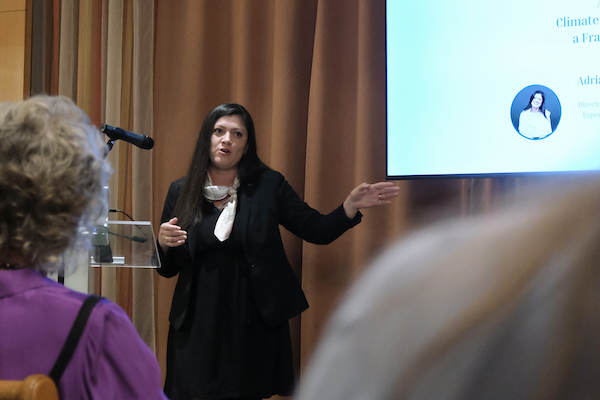
 Adriana González, Lead Expert Reviewer, UN Climate Review;
Credit: Steven Miller, Chronicle.lu
Adriana González, Lead Expert Reviewer, UN Climate Review;
Credit: Steven Miller, Chronicle.lu
On the evening of Wednesday 7 October 2026, the Diplomatic Council (DC) Luxembourg Asbl hosted the lecture “10 Years from the Paris Agreement: Climate & Nature in a Fragmented World” at the Hotel Parc Belair in Luxembourg-Ville.
The lecture, which saw around 30 people in attendance, was opened by president of the Diplomatic Council Luxembourg Francis Hoogewerf, who welcomed the attendees and explained the origins of the non-profit association and the work of the wider Diplomatic Council.
Albert Barseghyan, board member of the Diplomatic Council Luxembourg, then introduced guest speaker Adriana González, Lead Expert Reviewer for the United Nations Climate Review, recounting how he first met her at the COP30 climate conference in Belém (Brazil) in 2025.
He detailed her background as an engineer, having studied industrial engineering in Costa Rica and sustainable energy in Germany, and as CEO and founder of EcoCitizen - the Luxembourg-based social and ecological impact organisation focused on sustainability, climate, nature and scientific research.
Albert Barseghyan noted that Adriana has also led the technical coordination at climate conferences and she is also a designated review expert for the United Nations Framework Convention on Climate Change (UNFCCC), for which she assesses how the signatories of international treaties on climate change, such as the Paris Climate Agreement, are meeting their agreed milestones. She is also part of the United Nations Women delegation as an expert advisor on climate change, gender and their relationship with technology.
Adriana González began her speech by thanking the Diplomatic Council Luxembourg for the invitation and opportunity to talk about the vocation which she said she has put “my heart, my soul and my entire life” into. She also noted her gratitude for the “privilege” to study for a very high-level university degree in science technology and mentioned fellow Costa Ricans Franklin Chang-Díaz (Astronaut) and Christiana Figueres (Diplomat and Climate Activist) as her main inspirations.
Adriana González then referenced the signing of the Paris Agreement at the 2015 United Nations Climate Change Conference (COP 21) and noted that, even today, the event “still gives me some feelings, profound inspiration, because for the first time ever humanity agreed on one thing.” However, she remarked that the 2015 global agreement on the reduction of climate change was not without its problems, particularly with how its target of limiting the global temperature increase to 1.5°C above pre-industrial levels has been communicated to the public.
Adriana González detailed that although the Paris Agreement ensured that every country had its contribution and their sovereignty was respected, it is an agreement which means that the specific climate goals are politically encouraged, rather than legally bound. Only the processes governing the reporting and review of these goals are mandated under international law. “Every country undergoes a peer review which is not punitive,” said Adriana González.
She added: “[In my assessments] I cannot say a country is not doing enough or the measures or policies are not okay. I cannot do that. I cannot make this judgement. What I can do is assess if the commitment in the reporting is being done. And that is part of the value as well because it is not hierarchical. It is not like a punishment. But it is a bit of shame, diplomatic shame that nobody wants to have from a big recommendation from a technical review panel.”
Despite this limitation, Adriana González noted the value of the Paris Agreement, stating: “Without [it], we would be heading into five degrees of warming and that is not possible for life.” She acknowledged that limiting temperature rise to 1.5°C is now unlikely but the implications of the climate change agreement can help humanity face the challenges and the transformation of the world’s economies, food systems and health systems in the face of rising temperatures.
Adriana González also noted the positive impacts of the transition to renewable energy sources such as wind power and solar, highlighting that even the conservative state of Texas (US) was now at the forefront of the clean energy transition, despite the protestations of the current President of the United States of America and his dislike of “woke” ideologies and preference for fossil fuels.
Adriana González was pragmatic when it came to the ultimate impact of individual environmental efforts such as recycling or reducing one’s meat consumption, preferring to highlight the need for governments, investors and people to hold the world’s highest polluters to account.
She said: “We have to vote. We have to get involved. It is not a matter of just what you are doing in your household. It is where your pension funds are, for example. Have you ever checked if your pension is funding a fossil fuel company? Or have you checked if your money is going towards war, for defence? That makes a big difference. And that is what the needle needs to be turned around.”
She concluded: “We have the power in our hands… It is the time to be courageous and not to believe in misinformation.”
The event continued with a Q&A session during which members of the audience questioned Adriana González on a variety of subjects relating to climate change enforcement efforts, government policy and political accountability in the face of the climate crisis.
The event then concluded with food and refreshments supplied by the organisers.
The next Diplomatic Council lecture will be on the subject of “The Benefits of Nuclear Power in Luxembourg” and will take place at 18:30 on Tuesday 20 October 2026, at Cercle Cité’s Henri Beck Auditorium in Luxembourg-Ville. Further information can be found here.