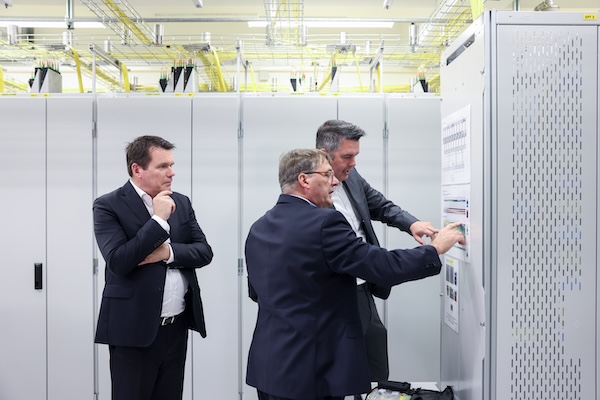
 (L-R) Claude Strasser, Director General of POST Luxembourg; Gaston Bohnenberger, Director of POST Technologies; Lex Delles, Luxembourg's Minister of the Economy, SMEs, Energy and Tourism;
Credit: POST Luxembourg / Sophie Margue
(L-R) Claude Strasser, Director General of POST Luxembourg; Gaston Bohnenberger, Director of POST Technologies; Lex Delles, Luxembourg's Minister of the Economy, SMEs, Energy and Tourism;
Credit: POST Luxembourg / Sophie Margue
On Friday 3 July 2026, POST Luxembourg permanently decommissioned its analogue fixed-line network, marking the completion of the transition to a network based entirely on Internet technologies (100% All-IP) and bringing to an end a technology that had supported telecommunications in Luxembourg for nearly forty years.
The milestone was marked during a ceremony attended by Luxembourg's Minister of the Economy, SMEs, Energy and Tourism, Lex Delles, alongside representatives of POST Luxembourg. The company described the permanent decommissioning of EWSD (Elektronisches Wählsystem Digital) technology, introduced in the 1980s to provide digital telephone call switching, as the completion of Luxembourg's transition to telecommunications infrastructure fully based on IP technologies.
According to the company, the continued growth in digital services and connectivity needs has driven the modernisation of its telecommunications infrastructure. The widespread deployment of All-IP technologies and fibre-optic networks is gradually replacing the historic copper network. This modernisation simplifies the network architecture, reduces maintenance costs, lowers energy consumption and improves the quality and functionality of communication services.
Gaston Bohnenberger, Director of POST Technologies, said: "The decommissioning of EWSD closes an important chapter in the history of Luxembourg's telecommunications. After nearly forty years of service, this technology is giving way to a network entirely based on IP technologies. Thanks to the deployment of fibre optics, which now covers more than 92% of households in the country, Luxembourg has a high-performance fixed network capable of meeting the growing connectivity needs of citizens and businesses."
POST Luxembourg also highlighted the evolution of the country's telecommunications network. In the early days of telephony, calls were connected manually by operators working in telecommunications centres before technological advances gradually automated the process.
The introduction of EMD (Edelmetall-Motor-Drehwähler) technology in the 1950s enabled the gradual automation of telephone call switching, replacing manual operations. From the 1980s onwards, EWSD (Elektronisches Wählsystem Digital) technology introduced digital switching based on computer systems to route telephone calls, paving the way for today's fully IP-based network.