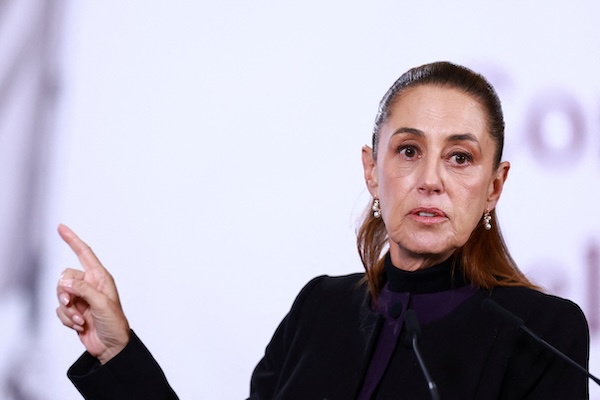
 Mexico's President Claudia Sheinbaum speaks during a press conference at Palacio Nacional, in Mexico City, Mexico, Monday 23 February 2026;
Credit: REUTERS/Raquel Cunha
Mexico's President Claudia Sheinbaum speaks during a press conference at Palacio Nacional, in Mexico City, Mexico, Monday 23 February 2026;
Credit: REUTERS/Raquel Cunha
MEXICO CITY (Reuters) - Mexico President Claudia Sheinbaum said on Tuesday 24 February 2026, there was "no risk" to fans coming to the country for the 2026 FIFA World Cup, after violence erupted following the capture and death of Mexico's most-wanted cartel leader, notably in Jalisco state.
Sheinbaum said "all the guarantees" for safety were in place for the top international soccer tournament, which is expected to draw hordes of fans from around the world to matches in Mexico City, Monterrey and Jalisco's capital Guadalajara.
She said during her daily morning press conference the situation was normalising, with security forces working to safeguard the public, after loyalists of cartel leader Nemesio Oseguera set up roadblocks and torched buses and stores across the country in retaliation for his slaying in a military raid on Sunday 22 February.
FIFA President Gianni Infantino told reporters on Tuesday 24 February that he was feeling "very calm" about Mexico hosting this summer's tournament. "Everything is going to be spectacular," he said.
A spokesperson for FIFA said the organisation was closely monitoring the situation and was in close contact with the authorities.
"We will continue to follow the actions and directions from the different government agencies, aimed at maintaining public safety and restoring normalcy, and we reiterate our close collaboration with federal, state and local authorities," the spokesperson said.
Jalisco Governor Pablo Lemus on Tuesday 24 February reaffirmed the state's participation in the tournament and confirmed a series of upcoming events in the region.
“There is absolutely no intention on FIFA's part to remove any venues from Mexico. The three venues remain completely firm,” Lemus said.
Mexico is set to host thirteen of 104 World Cup matches. Four of these are set to be held in Guadalajara. It will also host some preliminary warm-up matches before the tournament opens on 11 June 2026.
Local Mexican leagues postponed some matches that had been scheduled for Sunday 22 February, the day cartel members coordinated a series of violent attacks across the country in the aftermath of an operation to capture Oseguera, known as "El Mencho".
Sheinbaum has largely followed the political map of her predecessor Andres Manuel Lopez Obrador, who prioritised alleviating poverty and other root causes of violence, adopting a slogan of "hugs not bullets."
Asked whether the killing of Oseguera marked a break from that policy, Sheinbaum said this would never be the case.
"The detention of a suspected criminal with an arrest warrant can generate this type of circumstance, but we are looking for peace, not war," she said.
The arrests of other top cartel figures in Sinaloa state have in recent years also triggered cartel retaliation, including shootouts and vehicles set on fire.