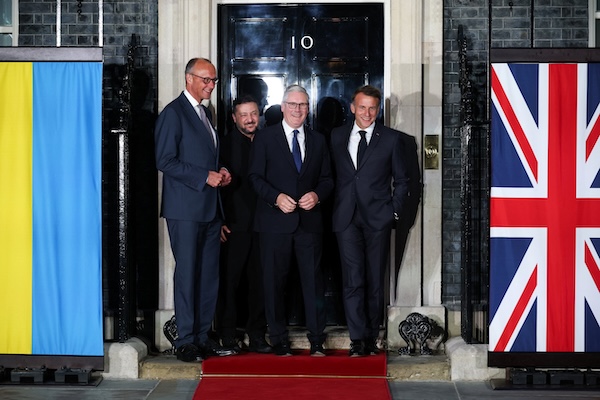
 British Prime Minister Keir Starmer, Ukrainian President Volodymyr Zelenskiy, French President Emmanuel Macron and German Chancellor Friedrich Merz meet at 10 Downing Street, in London, Britain, Sunday 7 June 2026;
Credit: REUTERS/Isabel Infantes
British Prime Minister Keir Starmer, Ukrainian President Volodymyr Zelenskiy, French President Emmanuel Macron and German Chancellor Friedrich Merz meet at 10 Downing Street, in London, Britain, Sunday 7 June 2026;
Credit: REUTERS/Isabel Infantes
LONDON/KYIV (Reuters) - The leaders of the United Kingdom, Germany and France said on Sunday 7 June 2026, they supported a proposal for talks between Ukrainian President Volodymyr Zelensky and Russian President Vladimir Putin to try to secure a ceasefire, and Europe would play a role.
In a joint statement, British Prime Minister Keir Starmer, German Chancellor Friedrich Merz and French President Emmanuel Macron commended Zelensky's call for an end to the war and the proposal for direct dialogue between Ukraine and Russia, with active US and European participation.
The three leaders, who head an informal security alliance called the E3 that is one of Ukraine's main sources of international support, were joined on Sunday by Zelensky in Downing Street.
"Leaders commended President Zelensky's call for an end to the war, negotiated by diplomatic means, as set out in his letter to the president," Sunday's joint statement said.
Zelensky said in a post on X that he also told Starmer Ukraine needed more missiles for air defence systems, just days after he published an open letter to Putin proposing face-to-face talks about ending the war, now in its fifth year. Zelensky's proposal was rebuffed by the Russian president.
Europe involved
In his letter, Zelensky said Russians had grown tired of Ukrainian missile and drone attacks, high inflation and fuel shortages, and were ready for peace.
He also said that, with the US focused on the conflict in Iran, "It would be wrong to simply wait until the war in Europe returns to the centre of its attention".
Putin said the offer did not come across as sincere and he currently saw no point in meeting, adding an agreement for the long term was needed.
In London, Zelensky was meeting the three leaders after his country had recently been hit by some of the biggest Russian air raids since the start of the 2022 war, including on Kyiv.
"Russia is not winning on the battlefield, and our mid-range strikes and deep strikes are significantly limiting its ability to expand its aggression. But it is also extremely important to have protection against ballistic threats, with which the Russians are terrorizing our cities and communities," Zelensky said.
The European leaders and Zelensky set out the conditions that would need to be in place to secure a "just and lasting peace", starting with an immediate and complete ceasefire.
They said the current line of contact should be the starting point for talks, that Ukraine should have legally binding security guarantees, including the deployment of a multinational force, and that Russian assets would remain immobilised until Russia had compensated Ukraine for the damage caused by the war.
Finally, the four leaders said any European security interests must be safeguarded.
Zelensky said on X that the leaders discussed possible ways to reinvigorate diplomacy and Europe’s role in this process.
"For Ukraine, it has always been a priority that Europe’s position and voice in the negotiations be strong," he said.
Starmer, in a post on X after the meeting, said Britain would stand with Ukraine as long as needed.
"Our support for Ukraine is ironclad," Starmer wrote. "Ukraine's security is Europe's security."
Putin stuck to his hardline stance on the war in a meeting with international media on Thursday 4 June, but he also said US President Donald Trump's proposals for peace could end the fighting if Kyiv were ready to compromise.