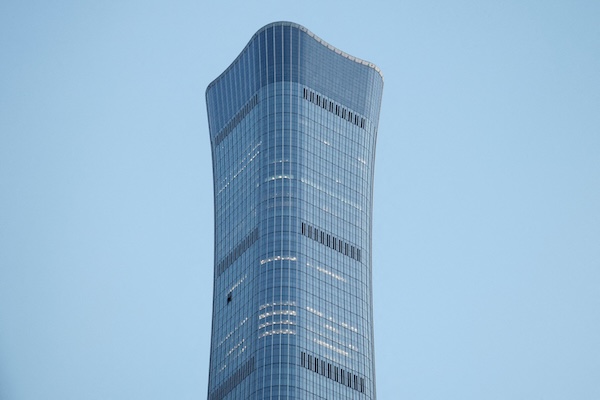
 FILE PHOTO: The CITIC Tower, also known as China Zun, where damage is visible on a high floor of the exterior, in Beijing, China, 26 June 2026;
Credit: REUTERS/Maxim Shemetov/File Photo
FILE PHOTO: The CITIC Tower, also known as China Zun, where damage is visible on a high floor of the exterior, in Beijing, China, 26 June 2026;
Credit: REUTERS/Maxim Shemetov/File Photo
(Reuters) - An unexplained crash involving a light aircraft that struck Beijing's tallest building on Friday 26 June 2026 and the subsequent silence from Chinese regulators have had a chilling effect on China's low-altitude aviation sector and exposed aviation safety gaps in the Chinese capital.
At least one Beijing-based provider of scenic flight services has halted tours. Another in the eastern city of Qingdao has suspended its services after the crash into the 108-storey CITIC Tower last week killed the plane's pilot and injured thirteen other people at the site.
"There has been a nationwide suspension because of the security incident in Beijing," Beijing Capital Helicopter told Reuters, adding that it did not know when services would resume.
"It could take one or two months. We are also waiting for the official notification."
Qingdao Hengyi General Aviation cited control measures for its suspension, saying it was unclear when restrictions could be lifted.
Calls by Reuters to some of the country's more than 100,000 low-altitude related companies suggested uncertainty on the ground, pending public guidance from the Civil Aviation Administration of China (CAAC).
Hongyan General Aviation, which runs flights in places including its home base Sichuan, Guangdong, as well as Xinjiang, said its flight training programmes and experience-flight services were operating normally.
Another aviation school, in central Hubei province, said it was accepting bookings this weekend.
CAAC has said China's low-altitude economy, encompassing manned and unmanned aviation services at low elevations, would expand into a 3.5 trillion yuan (€452.5 billion) market by 2035 and become a strategic growth industry for China.
Discussions scrubbed
Beijing district authorities said an investigation into the crash was underway. The pilot who died was not named. The building was also not disclosed in their statement.
"A single-engine, two-seat light sport aircraft collided with a high-rise building while flying near the East third ring road in Chaoyang (district) at 05:55 (11:55 CET) on 26 June 2026," district authorities said on Saturday 27 June 2026.
The statement was reposted by state-run Beijing Daily. But national media outlets including Xinhua news agency and China Central Television have yet to report on the incident.
Discussion of the crash on Chinese social media has since been scrubbed.
Bystanders taking photographs and videos in the vicinity of CITIC Tower on the day were told by police to delete footage from their mobile phones, according to Reuters witnesses.
Safety gaps
It was unclear how the plane was able to enter an area next to a permanent no-fly zone that includes offices of the central government and the ruling Communist Party.
CAAC did not respond to Reuters requests for comment.
"Without knowing a lot of detail, the incident exposes a gap in the ability of aviation and defence authorities to prevent such an incident, whether intentional or otherwise," said Keith Tonkin, managing director of Aviation Projects, a consultancy based in Australia.
"There may be specific measures in place in Beijing of which we are unaware, in which case there will be some concern about their effectiveness."
The aircraft also crossed highly restricted airspace used by commercial jets arriving at and departing from Beijing Capital International Airport, one of Beijing's two major airports.
A Hainan Airlines Airbus A330 jet flying from Urumqi in northwestern China abruptly arrested its descent to the airport and climbed to higher elevations around 09:50 GMT (11:50 CET) after its path intersected with the twin-seat aircraft, a Reuters review of data from flight-tracking service provider Flightradar24 showed.
The passenger jet landed roughly 30 minutes later.
Hainan Airlines did not respond to a Reuters request for comment.
Chinese regulations require all flights, including non-airline general aviation, to be approved in advance. General aviation operators must submit detailed flight plans to flight-control authorities before 03:00 (09:00 CET) on the day before take-off. Flying over urban areas is generally prohibited under China's civil aviation laws.
"The incident will no doubt result in even more careful consideration of how to realise the value of the low-altitude economy while managing the low but real risk of an aircraft either intentionally or accidentally flying into a building or other high-value infrastructure," said Tonkin.