 Credit: Ali Sahib, Chronicle.lu
As we start the annual evolution from hot and dry summer to cold and wet winter, autumn in Luxembourg brings with it a surprisingly varied calendar of harvest-related traditions and community events, from fruit picking and local fairs to initiatives encouraging people to collect produce that might otherwise go to waste.
I had never really paid much attention to how many events in Luxembourg at this time of year are connected in one way or another with the harvest. But after spending a second autumn closely following what is happening around the Grand Duchy, I have started to notice a certain seasonal rhythm. Often it is through social media that one suddenly comes across a traditional nut or plum fair, an invitation to pick apples or another local event that seems to belong specifically to these few weeks of the year.
Having children has probably made me notice these activities even more. You can tell them that fruit and vegetables are good for them, but it is much more interesting to take them closer to nature and let them see where some of that food actually comes from, perhaps even picking it themselves. And the more I looked, the more I realised how many different harvest-related activities are organised by both local and international communities in Luxembourg – not only for younger visitors, of course, but also for adults looking for an excuse to leave the city behind and spend an autumn day closer to nature.
A yellow ribbon means you may pick fruit
One initiative that particularly caught my attention was the “Gielt Band” (yellow ribbon). The idea could hardly be simpler: when a yellow ribbon is tied around a fruit tree, its owner is signalling that people are welcome to pick the fruit for their own use, without charge..
Yet there is more behind that small yellow ribbon than simply finding a free apple or pear. The initiative is part of Luxembourg’s efforts to reduce food waste and make better use of locally grown fruit that might otherwise be left to rot on or beneath the trees. It is open not only to municipalities, but also to associations, businesses and private owners willing to make fruit from their trees available to the public.
And it has grown considerably. Launched in 2021, the Gielt Band initiative had expanded to 71 participating municipalities by 2025. The national Antigaspi website provides a map showing participating municipalities and the types of fruit trees available, although the exact location of individual trees is not necessarily provided and remains up to each participant to locate.
In the south of the country, however, finding them can be much easier. The Minett region has its own interactive Tutti Frutti map, identifying around 80 public orchards with more than 2,600 fruit trees. For someone looking for an autumn outing – particularly with children – it turns the idea into something very practical: open the map, find an orchard and check which fruit trees are available for picking.
From picking apples to making cider
Of course, picking fruit in Luxembourg is not limited to trees marked with yellow ribbons. In Steinsel, the traditional Steeseler Äppelfest (Apple Festival) offers another opportunity to spend time among apple trees while enjoying a local community event. Organised by the basketball supporter club Amicale, the festival takes place over three weekends this year: 26-27 September, 3-4 October and 10-11 October, at the Vergers de Steinsel. Visitors can pick apples and enjoy local apple specialities, including freshly pressed Steeseler Viz and apple fritters.
I had the chance to visit the festival with my family, and we thoroughly enjoyed our time there. There were plenty of other families too, which added to the welcoming atmosphere. Interestingly, what my sons enjoyed most were the wheelbarrows provided for transporting the collected apples in boxes and bags. In their case, however, the wheelbarrows served a slightly different purpose, with my older son giving his younger brother rides around the orchard.
Such wheelbarrows are also used for other harvest-related fruit and vegetable farms, including the pick-your-own pumpkins in Keispelt, amongst others.
What I particularly like about events like this is that they make something as ordinary as an apple or a pumpkin feel a little less ordinary. Rather than simply buying a bag at the supermarket, you can spend time in an orchard, see the fruit growing on the trees and discover some of the products made from it. And, as my sons demonstrated, sometimes the simplest things provide the most entertainment.
Picking apples is only one part of the story, however. Another is what happens to the harvest afterwards. In Born, Luxembourg cider producer Ramborn Cider Co uses fruit from traditional meadow orchards to produce cider, juices and other drinks. The company also organises harvest-related activities, including its annual Public Harvesting Day, offering visitors an opportunity to learn more about traditional orchards and cider-making, as well as the sustainable farming practices they adopt.
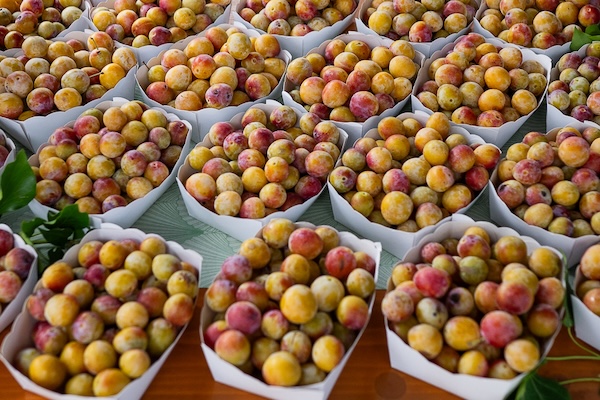
And apples are not the only seasonal produce being celebrated. The weekend of 10-11 October 2026 alone offers several examples: the Vizfest mat Hobbymaart in Echternach combines an apple festival with a creators' market, while the Quetschefest in Larochette celebrates plums with local specialities and live music.
On Sunday 11 October, Vianden will host its traditional Veiner Nëssmoort (Nut Fair), dedicated to walnuts and walnut-based products. Three different towns, three different celebrations, all reflecting how closely local community events remain connected to the autumn harvest.
Harvest traditions from further afield
Luxembourg's autumn harvest traditions are not limited to its orchards, local festivals or cider production. In a country with such a diverse international population, this time of year also brings celebrations maintained by communities with roots elsewhere.
One example is the Anglican Church of Luxembourg, which held its Harvest Thanksgiving celebrations at Konvikt Chapel on Sunday 27 September 2026. Alongside the religious services, the programme included an event called "Harvest around the World – Bring & Share Hospitality", while participants were invited to bring harvest gifts for FMPO. It is an example of how a traditional celebration of the harvest can also become an opportunity to share food and support others.
Across the Atlantic, Thanksgiving has its own history and traditions, which are also celebrated by the American community in Luxembourg. The American Chamber of Commerce in Luxembourg (AMCHAM), for example, will hold its annual Thanksgiving Gala Dinner at Cercle Cité in Luxembourg-Ville on Friday 20 November 2026. This year's black-tie event will also mark the organisation's 30th anniversary, bringing together guests for an evening of dining, music and dancing.
These occasions may be quite different from picking apples in Steinsel or discovering traditional orchards in Born. Yet they illustrate how autumn traditions can take different forms in Luxembourg, from harvesting fruit and producing local cider to sharing food, expressing gratitude and bringing communities together.
When I first started looking into Luxembourg's autumn harvest activities, I was mainly searching for something interesting to do with my children. What I discovered was a much wider range of local and international traditions than I had expected.
But perhaps what has stayed with me most is the simplicity of the Gielt Band initiative. In a country as wealthy and modern as Luxembourg, the idea that someone with more fruit than they need can simply tie a yellow ribbon around a tree and invite strangers to help themselves seems rather refreshing. It brings together several things that are often discussed separately: preserving local traditions, reducing food waste and sharing something with the wider community.