 Maximilian Böhm;
Credit: maximilianboehm.com
Maximilian Böhm;
Credit: maximilianboehm.com
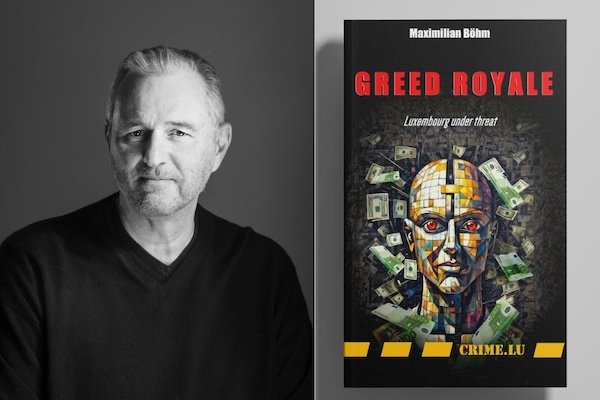
Luxembourg-based author Maximilian Böhm has released the English-language edition of his latest crime thriller, Greed Royale – Luxembourg under threat, which uses Luxembourg's financial centre as the setting for a fictional story exploring competition, artificial intelligence (AI), ambition and moral grey zones.
The novel revolves around a mysterious portfolio manager from Hong Kong who arrives in Luxembourg with a revolutionary AI-driven fund promising to strengthen the Grand Duchy's position amid competition from rival European financial centres. Behind its apparent success, the story explores greed, ambition and hidden interests within the financial world.
The English-language release follows the German edition, Gier Royal, published by Luxembourg-based publishing house crime.lu. Maximilian Böhm, who has German roots, said his novels are closely connected to the Grand Duchy and aim to reflect its international character, ambition and complexity. He expressed hope that Greed Royale could help readers see Luxembourg "not only as a financial hub but also as a stage for literature and imagination".
To mark the release of the English edition, Chronicle.lu spoke with Maximilian Böhm about drawing on his experience in finance, returning to Luxembourg as a literary setting and the Grand Duchy's cultural identity.
Chronicle.lu: As you described, the book explores themes of "greed, ambition, AI and moral grey zones". Did the inspiration come from any particular personal experiences of living and working in Luxembourg?
Maximilian Böhm: The inspiration certainly came from many years of observing the financial world from the inside - not in the sense of writing an exposé, but in the sense of understanding its atmosphere, its language, its ambitions and sometimes also its contradictions.
I have spent a long part of my professional life in finance, in different countries and different roles, and one thing becomes clear over time: the financial world is not fundamentally different from other sectors. It is made up of people, and people bring with them ambition, fear, vanity, courage, loyalty and, yes, sometimes greed. What makes finance so fascinating - and also so vulnerable to criticism - is that it deals with money, and money has impact.
Luxembourg is, in my view, a very strongly regulated financial centre. It is not an easy place for anyone who believes they can simply cheat the system. But no system in the world is entirely free from loopholes, temptations or moral grey zones - not in finance, not in politics, not in art, not in any other sector. For a writer, these grey zones are extremely interesting.
Chronicle.lu: Your first novel Bar Luxembourg was also set in Luxembourg, and you have now returned to the Grand Duchy as the setting for Greed Royale. What drew you back and has the way you portray the country changed over the years?
Maximilian Böhm: Bar Luxembourg was written from a different perspective. It was more of an episodic novel, strongly focused on characters, encounters and the impressions I had when I first came to Luxembourg. What fascinated me then was this incredible internationality in such a small space. You can sit in a bar, walk through the city, attend a reception or a cultural event, and within minutes you hear several languages, meet people from different countries and sense how many worlds coexist here.
Over the years, Luxembourg has changed considerably. I sometimes describe it as perhaps the smallest metropolis in Europe. That may sound like a paradox, but I think it captures something essential: Luxembourg has the density, ambition and international rhythm of a much larger city, while still preserving a sense of proximity that is rare elsewhere.
In Greed Royale, my portrayal of Luxembourg is therefore different from Bar Luxembourg. It is no longer only the country of first impressions, cafés, conversations and encounters. It is also a place of global relevance, political and economic transformation, financial competition and social change.
I am a great admirer of this development, although of course such growth also has to be guided carefully. International success brings opportunities, but also pressure. It changes the social fabric, the housing market, the cultural landscape and the way people perceive the country from outside. For a novelist, this is extremely rich material. Luxembourg is not merely a backdrop for me; it is almost a character in itself - elegant, ambitious, discreet, multilingual, sometimes underestimated and full of stories.
Chronicle.lu: You have the rather unusual combination of professional experience in finance and a passion for literature. Luxembourg is internationally known as a financial centre but how do you see its identity when it comes to literature and other art forms? Do you think the Grand Duchy has a distinctive cultural or artistic voice that deserves greater recognition internationally?
Maximilian Böhm: Luxembourg certainly has a cultural identity and I think it is becoming stronger. The state, the municipalities and many institutions do a great deal to support cultural life. There are remarkable concerts, theatre productions, festivals, exhibitions and literary events.
I remember attending a Peter Fox concert at Usina festival in Dudelange and standing perhaps fifteen metres from the stage. In Berlin, that would be almost unthinkable because of the sheer size of the crowds. I also remember seeing Anna Karenina at the national theatre - a highly cultural, intense theatre evening - and again there was this feeling of closeness to the actors, to the artistic moment itself. Luxembourg often allows a kind of cultural intimacy that larger countries sometimes lose.
At the same time, Luxembourg's cultural voice is not simple or one-dimensional. Its identity is mixed - and I mean that as a strength. In a world where many societies struggle with internationalisation, Luxembourg lives it every day.
I do believe this cultural and artistic identity deserves greater international recognition. Luxembourg is often viewed from the outside mainly as a financial centre, a European capital or a place of institutions. All of that is true but it is incomplete. There is also a literary, theatrical, musical and artistic Luxembourg, and it is growing.
Further information about Maximilian Böhm books and background is available on his homepage: www.maximilianboehm.com