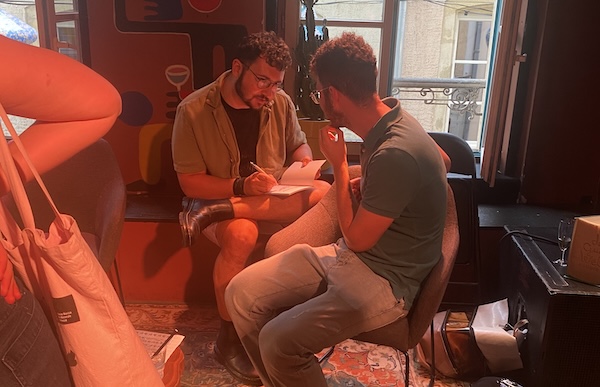
 Photo from the book launch on Thursday 16 July 2026, (L-R) Flame Darinov; n/a;
Credit: Black Fountain Press
Photo from the book launch on Thursday 16 July 2026, (L-R) Flame Darinov; n/a;
Credit: Black Fountain Press
It has been one month since Black Fountain Press launched Saudade, I Spoke Your Language, a new poetry collection by Flame Darinov.
Launched on Thursday 16 July 2026, the book was presented by the author and Black Fountain Press at De Gudde Wëllen in Luxembourg-Ville.
During the launch event, Anne-Marie Reuter, co-founder and publishing director of Black Fountain Press, said: "Saudade, I Spoke Your Language is a sumptuous, cross-language love story in thirty poems. It's a collection in English and Brazilian Portuguese (with English translations). We exceptionally chose to open up our English-language catalogue to celebrate diversity and multilingualism."
The 74-page collection features thirty poems in English and Portuguese, with English translations, and explores the search for same-sex love against a backdrop of what the author describes as "growing isolation and worldwide post-2020 uneasiness".
Born in Sofia, Bulgaria, Flame Darinov has lived in Luxembourg's Minett region since 2017 and acquired Luxembourgish nationality in 2025. He studied and worked at the University of Luxembourg, where he co-founded the student poetry club PULSE. He has also taught poetry both as an academic subject and as a creative practice.
His new collection draws on his own experiences of love, language and life in Luxembourg, while also reflecting on queer identity and belonging in a multilingual society. Following the launch, Chronicle.lu spoke with the author about his work.
Chronicle.lu: Who is this collection intended for, and what kind of reader do you think it will connect with it most?
Flame Darinov: It's hard for literature in Luxembourg to find its audience. So much separates the people here: the languages, our origins, our desires and literary interests... I try to find something that can bring readers in this country together. At the risk of putting it too plainly, this book is about learning how to love across cultures and languages. The topic is very “Luxembourgish” in some ways: more than half the population comes from abroad, so probably at least half of us date outside what we know at some point. I am surprised this is not a common topic - perhaps it's too personal.
I expect these texts to resonate the most with other people like myself: queer men who moved to Luxembourg and fell in love with its complicated diversity of languages. That said, I hope my texts speak more widely to people who (wish to) see the world in a loving, less solitary way.
Chronicle.lu: To what extent is Saudade, I Spoke Your Language inspired by your own real-life experiences, perhaps also when it comes to love?
Flame Darinov: At first, this book was entirely me projecting myself as a loving man: How would I learn his mother's language? How would I show him 'eis kleng' here in Luxembourg? How public can we be with showing affection? What parts of my own culture do I want to share? For me, the content can be scorchingly raw. However, my style tends to be more meditative and reflective, so it might not come across that way.
My naked soul is in “saudade”. Anyone could read it right there: ugly crying on the train, an STD scare, an encounter at the sauna, homophobia in public. It's embellished in a rhyme or two but it's there.
Chronicle.lu: What does it mean to write openly about same-sex love while based in Luxembourg?
Flame Darinov: Though it's not perfect, Luxembourg is a comparatively safe country for same-sex love. I hold my partner's hand everywhere and, luckily, I feel safe enough to show him affection anywhere. But I never want to take this safety for granted. I want to remember the names and achievements of the queer community in the Grand Duchy, my newest home, as well as other places across Europe. Does this make the book “political”?
I don't know - is anyone's existence political? I invite the readers to answer this question for themselves.
Chronicle.lu: What do you hope readers will take away from this collection?
Flame Darinov: First, find yourself however you can - in the English language, in the love story, in Luxembourg. And then, just as so often we do in our small haven, cross into what you don't know: into that foreignness, that queerness; the Portuguese; in your hands.