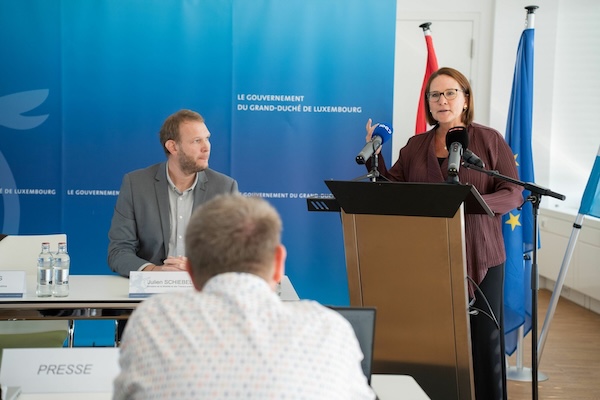
 (L-R) Julien Schiebel, Ministry of Mobility and Public Works; Yuriko Backes, Luxembourg's Minister for Mobility and Public Works;
Credit: MMTP
(L-R) Julien Schiebel, Ministry of Mobility and Public Works; Yuriko Backes, Luxembourg's Minister for Mobility and Public Works;
Credit: MMTP
On Thursday 10 September 2026, Luxembourg's Ministry of Mobility and Public Works presented the first results of the national Luxmobil 2025 mobility survey, which provides new data on mobility behaviour among residents and cross-border workers and will serve as a basis for the future National Mobility Plan 2040.
The survey, presented by Minister for Mobility and Public Works Yuriko Backes, was conducted among 9,000 residents and cross-border workers. It provides a reference source for better understanding mobility behaviour linked to Luxembourg and supporting the development of public mobility policies. The survey focused on working days outside school holidays, meaning that the figures presented relate to mobility behaviour on a working day. A smaller sample of residents was also surveyed about Saturdays.
“The results of Luxmobil 2025 demonstrate that the transformations undertaken in recent years are bearing fruit. The modal shift towards alternatives to the car is progressing, the use of public transport is increasing and sustainable mobility solutions are gaining ground. This confirms that consistent and sustained investment in transport infrastructure and services can change behaviour. Preparing tomorrow’s mobility requires a long-term vision and the continuation of the efforts already undertaken. In terms of mobility, the benefits are measured in improved quality of life and increased attractiveness for our country,” stated Minister Backes.
Changing mobility patterns
Eight years after the first edition of Luxmobil in 2017, Luxembourg has undergone significant demographic, economic and territorial changes. The country now has nearly 90,000 additional residents and around 50,000 additional cross-border workers.
At the same time, the mobility offer has changed significantly, notably with the introduction of the tram, the development of teleworking, increased bicycle use, the opening of Howald railway station and the reorganisation of public road transport networks. In this context, updating mobility data was necessary in order to obtain an accurate picture of current and future needs.
The survey was conducted under the scientific coordination of the Luxembourg Institute of Socio-Economic Research (LISER) and the Centre for Studies and Expertise on Risks, the Environment, Mobility and Urban Planning (Cerema), with support from Ilres for data collection. According to the ministry, this ensured the scientific quality and representativeness of the data collected. The results are accessible to the general public via an interactive website allowing users to explore the different mobility indicators.
Daily mobility behaviour
The survey highlights the diversity of journeys made on a daily basis. On a working day, residents and cross-border workers generate three major mobility peaks during the day, with characteristics varying according to profile.
Home-to-work journeys are the most frequent trips, but account for only 17.2% of all daily journeys made by residents. Work-related and leisure journeys remain the main reasons for mobility, illustrating the range of activities that shape daily travel.
The results also show that journeys are mainly organised within the same geographical area. The choice of transport mode varies according to the distance travelled. Walking predominates for short journeys, while the car retains an important role for longer journeys.
The study also highlights an increase in multimodality, with users combining several modes of transport during the same journey as distances increase.
Excluding the 12% of residents who do not leave their homes on a working day, residents spend an average of one hour and 44 minutes travelling. Cross-border workers have longer travel times, reaching almost two hours and 20 minutes per day for those living in Germany.
Despite these constraints, satisfaction levels remain high. A total of 77% of residents said they were satisfied or very satisfied with their home-to-work journeys and 87% with their other daily journeys. Satisfaction with home-to-work travel among employees living in Germany, Belgium and France stood at 56%, 55% and 43% respectively.
Public transport and cycling gain ground
Between 2017 and 2025, mobility behaviour evolved in the desired direction. While the overall number of journeys increased by 14%, journeys made alone by car increased by 7%, car-sharing journeys by 17%, public transport journeys by 22% and bicycle journeys by 81% compared with 2017.
Walking now accounts for 23% of all journeys in the Grand Duchy of Luxembourg. The ministry noted that this figure is not comparable with that of 2017 for methodological reasons.
Among journeys made by modes other than walking, the share of trips made by individual car decreased from 55.7% to 52.5%. The modal share of car-sharing increased from 23.6% to 24.3%.
Public transport also recorded an increase, with its share rising from 18.6% to 20%, corresponding to around 72,000 additional journeys per day. Cycling recorded the strongest relative growth, rising from 2% to 3.2%.
According to the ministry, the comparison between Luxmobil 2017 and Luxmobil 2025 shows a modal shift in line with the objectives pursued by public mobility policies. The results confirm that investments made in recent years are contributing to strengthening the attractiveness of alternatives to individual car use and supporting changes in mobility behaviour.
Basis for National Mobility Plan 2040
As Luxmobil 2017 served as a basis for the National Mobility Plan 2035, the results of Luxmobil 2025 will form one of the main foundations for the development of the future National Mobility Plan 2040 (PNM 2040), which is scheduled to be presented in 2027.
In order to monitor changes in mobility behaviour more closely, the ministry is also considering developing the Luxmobil system towards a more regular observation model based on annual surveys among smaller samples. According to the ministry, this approach would provide continuously updated indicators and allow public policies to be adapted as closely as possible to the needs and expectations of the population, while taking demographic and economic developments into account.
A separate Luxmobil “Sunday” survey will be launched among residents on Monday 21 September 2026. Until the end of 2026, Ilres will contact a representative sample of households by telephone, with the option of responding in Luxembourgish, French, German or English.
The results will notably help determine whether the public transport offer corresponds to the population’s needs on a Sunday. Minister Backes thanked the 9,000 people who participated in Luxmobil 2025, as well as those who will take part in the survey on Sunday travel.