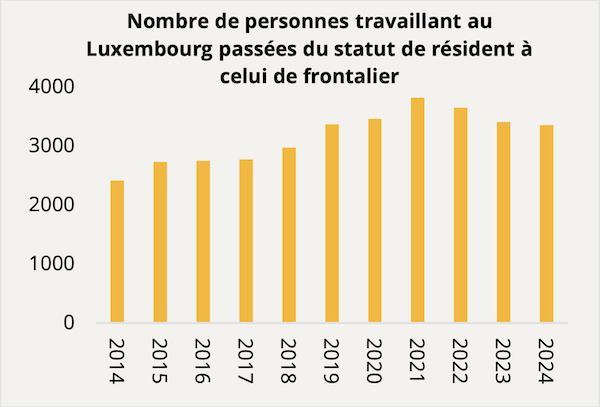
 Number of people working in Luxembourg who changed from resident to cross-border worker status (2014-2024);
Credit: IGSS
Number of people working in Luxembourg who changed from resident to cross-border worker status (2014-2024);
Credit: IGSS
On Tuesday 10 March 2026, Fondation IDEA Asbl published Analysis No. 54, titled “The Permanent Housing Crisis or the Unacceptable as the Norm”, an analysis by senior economist Michel-Edouard Ruben examining the housing crisis in Luxembourg.
According to the analysis, concerns about the share of household income devoted to housing in Luxembourg are not new. For decades, public authorities have sought to address the issue through an active housing policy. Measures have included legislation on affordable housing dating back to 1906, rent regulations introduced in 1955 and the creation of the Social Housing Fund in 1972, later renamed the Housing Fund.
Further initiatives followed over the years. A major law promoting access to home ownership for lower-income households and encouraging the construction of moderate-cost housing entered into force in 1979, while a Ministry of Housing was created in 1989. Subsequent reforms included fiscal measures aimed at encouraging private investment in real estate and policies intended to increase the availability of building land and housing.
The report noted that successive governments have continued to intervene in the housing market. During the 2000s, several legislative initiatives were introduced to encourage the release of building land and housing to the market and to support individuals seeking to purchase their own homes. In 2008, a law known as the Housing Pact was adopted with the objective of reducing or stabilising land and housing prices over the long term.
Housing policy continued to evolve in the following years. After the Juncker era, the so-called “Gambia coalition” governments (2013-2023) introduced additional measures, including rent subsidies, reforms linked to Housing Pact 2.0, new legislation on affordable housing and housing assistance, as well as a national strategy aimed at expanding affordable housing supply. These initiatives also included the creation of a special fund dedicated to affordable housing and a stronger role for public developers in the housing market.
Despite this long-standing intervention, IDEA said the analysis suggested that many of the structural challenges associated with Luxembourg’s housing market remain unresolved. High prices, limited construction volumes, land hoarding by property owners and lengthy planning procedures continue to contribute to tensions in the housing market.
According to the publication, the housing crisis has gradually become a form of “established disorder”, in which living in Luxembourg increasingly resembles a competition between households facing high prices and limited supply. In this context, some households are forced to devote a significant share of their income to housing due to the combined effect of high prices and insufficient supply.
At the same time, the analysis noted that a sharp correction in property prices is not necessarily desired. In a country characterised by a high rate of home ownership and strong property wealth accumulation, the resilience of the real estate market remains politically and economically sensitive.
Several examples illustrate the persistence of high prices in the housing market. The publication pointed out that the public housing developer SNHBM promoted its Elmen housing project through advertising campaigns abroad rather than reducing its sales prices. In another case, the Kirchberg Fund repurchased a large share of apartments in the Kiem 2050 project after demand proved insufficient at the initially requested prices.
The publication also noted that public policy frameworks continued to support relatively high price levels. For example, the Ministry of Housing considers construction costs of around €7,000 per m² (excluding land costs) as the maximum eligible amount for certain VEFA housing purchases. At the same time, certain legal provisions designed to limit the share of land costs in housing prices remain largely absent from public debate.
Meanwhile, the rental market remains tight. In some cases, housing formats such as co-living are being offered at price levels that may prove difficult even for relatively high-earning households to afford. At the same time, compliance with existing rent regulations does not always appear to be a priority.
More broadly, the publication argued that expectations of a significant increase in housing supply, often cited at around 6,000 homes per year, are unlikely to materialise in the near future.
Several structural factors were cited. Private developers, who are entitled to generate returns from the risks they take, may not necessarily wish to accelerate construction in ways that could destabilise the market. Opposition from residents to certain real estate developments, as well as environmental concerns, can also slow or block housing projects.
At the same time, the current capacity of the construction sector may be lower than in previous decades. Slower growth in employment within the construction sector, combined with the bankruptcy of several companies involved in housing production, has reduced the sector’s ability to significantly increase output.
The publication also highlighted the long-term absence of a coherent public land strategy. Many major housing developments today depend heavily on the redevelopment of former industrial sites such as Wiltz, Dudelange, Belval and Schifflange. This dependence limits the ability of public developers to act as large-scale builders capable of rapidly expanding housing supply.
In addition, building permits issued between 2023 and 2025, which serve as a leading indicator of future housing construction, suggest that the objective of completing around 6,000 homes per year is unlikely to be achieved in the short to medium term. The traditional financing model for housing construction in Luxembourg, based largely on VEFA sales, is also experiencing a period of declining confidence.
As a result, the publication suggested that Luxembourg’s housing crisis is likely to persist. Investment cycles in housing construction often fail to match projected demand, access to home ownership remains increasingly difficult for first-time buyers and rents continue to rise.
These dynamics contributed to broader economic, demographic and social tensions linked to access to housing. According to the analysis, many potential policy responses remain politically difficult, financially costly or socially controversial.
Measures such as stronger land taxation, construction obligations, stricter rent regulation or increased residential density often face resistance from different stakeholders. At the same time, large-scale public interventions such as expropriation or extensive land purchases could represent significant costs for public finances.
For these reasons, the publication concluded that the housing crisis may remain a structural feature of Luxembourg’s economic and social landscape for years to come.
As the analysis concluded: “The right to housing? Of course. But that does not necessarily mean that you must live in Luxembourg.”
The full analysis is available on the IDEA website.