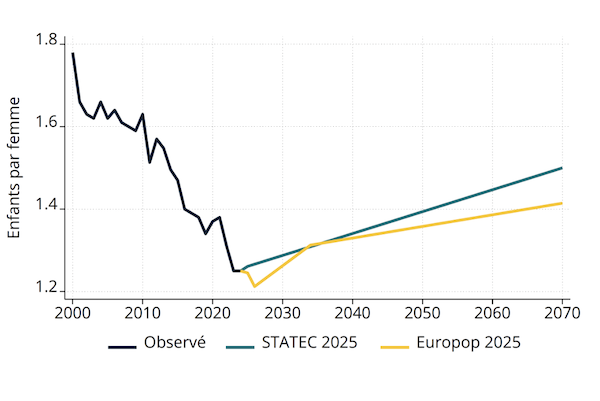
 Fertility rate projections for Luxembourg through 2070;
Credit: STATEC, Eurostat
Fertility rate projections for Luxembourg through 2070;
Credit: STATEC, Eurostat
On Wednesday 13 May 2026, following recent projections suggesting Luxembourg’s population could approach one million inhabitants by 2070, STATEC released additional demographic details highlighting the country’s expected population ageing, rising life expectancy and continued reliance on migration.
According to STATEC, while Luxembourg’s population is projected to continue growing over the coming decades, the country is also expected to experience significant ageing. The average age, currently around 40 years, could rise to approximately 46-48 years by 2070.
STATEC noted that migration is expected to remain the main driver of demographic growth and could partly offset the effects of ageing, particularly in the higher-productivity scenarios. In these scenarios, stronger immigration flows would help maintain a more favourable age structure thanks to a larger working-age population.
The statistical institute explained that the proportion of people aged 65 and over is projected to increase significantly by 2070. While both STATEC and EUROSTAT foresee a marked ageing trend, ageing is projected to be more pronounced in EUROSTAT’s projections, where lower migration levels towards the end of the projection period limit the contribution of younger workers.
The projections also indicate a gradual increase in life expectancy over the coming decades. By 2070, life expectancy at birth for women is projected to reach 90.3 years according to STATEC, compared to 89.9 years in EUROSTAT’s projections. For men, life expectancy is expected to reach 86.7 years according to STATEC and 86.0 years according to EUROSTAT.
Regarding fertility, STATEC projects a gradual increase in the total fertility rate from 2025 onwards, reaching 1.50 children per woman by 2070, compared to 1.41 projected by EUROSTAT. However, both institutions agree that Luxembourg would remain below the replacement threshold of 2.1 children per woman throughout the projection period.
STATEC noted that migration is expected to remain a key factor shaping Luxembourg’s demographic development over the coming decades, while also helping to offset part of the country’s projected population ageing.