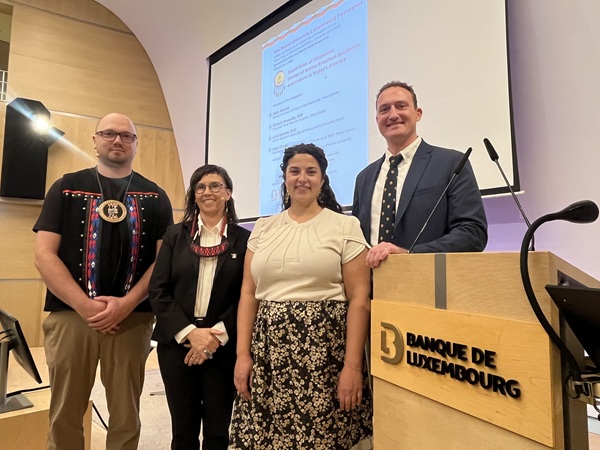
 (L-R): Nate Povfair, Nichole Prescott, Kara Strass, Miami Tribe; Nichole Prescott, Miami University, Ohio;
Credit: Chronicle.lu
(L-R): Nate Povfair, Nichole Prescott, Kara Strass, Miami Tribe; Nichole Prescott, Miami University, Ohio;
Credit: Chronicle.lu
On Tuesday 29 and Wednesday 30 September 2026, representatives of the Miami Tribe of Oklahoma in the United States were in Luxembourg, hosted by the Miami University Foundation Luxembourg - the Miami University John E. Dolibois European Center (MUDEC) in Differdange was established in 1968.
The visit was held under the tag line of "Native American resilience and culture in today's America", with three members of the delegation alumni of Miami University: Nate Povfair, tribal citizen and an elected member of the Miami Tribe leadership; Nichole Prescott, PhD, tribal citizen and Principal of More Than An Asterisk; and Kara Strass, tribal citizen and Executive Director of the Myaamia Center as of 2027; as well as Cam Shriver, PhD, Senior Research Associate of History at the Myaamia Center.
Background
The Miami Tribe of Oklahoma is a Federally Recognised Sovereign Nation (in Oklahoma) as defined by the US Department of Interior.
The Miami University is named after the Miami tribe whose people were forced from their homelands (in what is now Ohio, Indiana and Illinois) in the late 1840s. In the early 1960s, the last person who spoke Myaamia as an everyday language passed away, resulting in the tribe had now lost the language of its ancestors. Today, for the first time in almost a hundred years, a new generation of the Miami Nation speaks it again. The recovery is closely tied to Miami University.
A delegation of the Tribe and of Miami University in Ohio is visiting Luxembourg to share that story which began in 1972 when Forest Olds, then chief of the Miami Tribe, visited the university's campus which started a relationship which has now lasted 50+ years. In 1997 the University changed the name of its sports team to the RedHawks; in 2017, the university's President and the tribe's Chief signed an agreement and created a shared logo drawn from Myaamia paperwork, a traditional Miami art form.
In the 1980s, a citizen of the tribe, Daryl Baldwin, studied the language from old documents and trained in linguistics; from 1991, he and his wife raised their fouzr children speaking Myaamia at home. In 2001, the tribe approached the university to support this work and the Myaamia Project was created, becoming the Myaamia Centre in 2013, a research and education arm of the tribe. The result is a language which has come back into use as a new generation of tribal youth is learning and speaking Myaamia.
Wednesday
On the Wednesday, the Banque de Luxembourg in Luxembourg city held an event attracting 60+ attendees at which the made a short presentation then screened a short documentary film, followed by a round-table discussion, addressing the Miami Tribe of Oklahoma's contribution to the revitalisation of their language and culture, and an exhibition of Myaamia art.
Cam Shriver moderated the event and explained first that many Americans consider Europe as "old countries", with America as a "new country", but explained that this was not really true as its history shows "America is on old place", with many placenames taken from many years ago. He also talked about the deportation of members of the Miami Tribe in 1846 to the Kansas Reservation, and in 1867 to the Oklahoma Reservation. Today, over 7,000 members of the tribe live as a diaspora, scattered throughout the United States and even internationally. He talked about colonisation and globalisation, violence and forced removal of children from their parents, and more.
This presentation set the context for today's optimistic outlook about the recovery and revitalisation of the tribe's culture and language. Twho specific examples include the Stomp dance and te sport of Lacrosse.
The 16-minute short film addressed the tribe's history and geography and showed how Miami University has helped revitalise its culture and language.
Nate Povfair said that his life's honour is to serve the tribe and community. He explained that his ancestors went to Michigan where he was born and learned about Great States culture, before moving to Indiana. He had a tribal ID but knew little until he studied at Miami University when he was aged 25-30 years old. He developed interactions with other community members and later moved to Oklahoma to work directly as a tribal leader.
He also talked about the tribe's court system where they hold trials for crimes (not federal), as well as interacting with and teaming up with other tribes, "like a mini United Nations". He addressed citizenship, which he confirmed is based on ancestry.
Nichole Prescott said that her family had been put into the reservation in Kansas before moving to Oklahoma where she was born. Se grew up near the Mexico border but made frequent trips back to Oklahoma and participated in tribal meetings which she saw grow from around 10-20 people to around 250 nowadays. She was encouraged to go to graduate school and enrolled in Miami University. She has worked on the constitution and now works on the Miami University Foundation board using her administrative leadership skills.
She talked about tribal sovereignity and the differences between state and federal laws which she admitted lead to a "lot of administrative nightmares", addressing the difference between racial categories and political categories, with the issue currently being addressed by the Supreme Court.
Kara Strass is from the Miami Tribe in Oklahoma and grew up in Oklahoma where her ancestors escaped the forced removals. She explained that much of the tribe's culture and language were not passed down, but she learned what she could from family members. She went to college at Notre Dame but wanted to explore her culture and went to Miami University which allowed her the opportunity to explore who her tribe is and who she is herself. She recognises that it will take generations to recover the culture and language and is happy to be part of that path.
She explained that while there is currently nobody fluent in the language, there are hundreds of people who know some words and sentences. She revealed that currently she is involved in student course components entitled "Sovereignty and Contemporary Issues" addressing people who make decisions for themselves, while also liaising with the United States government, both federal and state, and with individual community members being involved. One of the ways of addressing this is through culture, through art.
She also talked about children's camps where they studied the language and practiced culture, around which they engaged using the language. They now have different age-group camps, with physical camps in both Oklahoma and Indiana, as well as online camps for others.
The last part pf the panel discussion addressed the issue of the future and whether the panellists saw opportunities or challenges ahead, with the answers being in both categories. Having the community (diaspora) spread wide geographically is certainly a challenge to preserving / growing the language, but could technology help? and how can the Myaamia Centre play an active role?
The screening and discussion had been preceded by a press conference at which the tribe's representatives shared the story of the Tribe's removal from its ancestral homelands to the current revival of its language and culture in America today.
On the Tuesday, a similar event was held at MUDEC in Differdange, with the focus more on the university and its role in revitalising the Myaamian culture and language.
Over the next few days, the tribal delegation will pay cultural visits to Vianden ans Schengen, as well as to Metz in France.