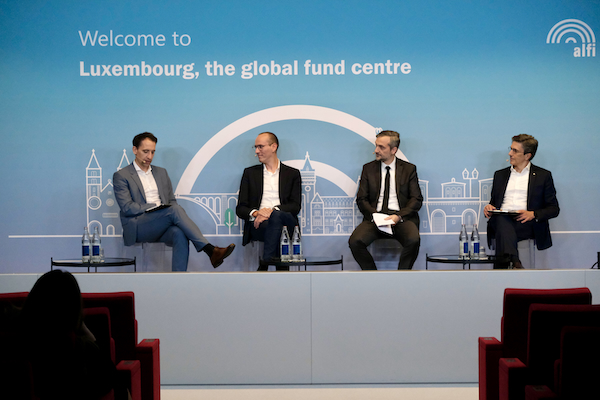
 (L-R) Jens Schmidt, EY; Remi Minnebo, Alter Domus; Stefano Portolan, Prometeia s.p.a; Francesco Battazzi, European Investment Fund;
Credit: Steven Miller, Chronicle.lu
On Tuesday 10 November 2026, the second day of the ALFI Private Assets Conference took place at the European Convention Center Luxembourg (ECCL) in Luxembourg-Kirchberg.
The two-day conference brought together fund professionals to discuss the latest market and regulatory developments with their peers and share best practices to lead their businesses to sustainable growth. During the second day of the event, the Association of the Luxembourg Fund Industry (ALFI) published the results of the KPMG/ALFI Private Debt Fund Survey 2026.
Chronicle.lu attended the closing session of the conference, “AI and private credit: opportunity, risk and underwriting”. The panel discussion was moderated by Jens Schmidt, partner at EY, and featured contributions from Francesco Battazzi, Head of Division - Private Credit at the European Investment Fund (EIF); Remi Minnebo, Director, Head of Cloud Platform Engineering at Alter Domus Luxembourg S.à r.l.; and Stefano Portolan, Associate Partner - Country Head - Wealth & Asset Management at Prometeia s.p.a. Luxembourg Branch.
The discussion touched on the subjects of investment in and financing of AI infrastructure, how AI will be a driver of change for private credit management, the importance of data and infrastructure sovereignty and how AI will be integrated into existing reporting and regulatory frameworks.
On the subject of the impact of AI on private credit as an investment, Francesco Battazzi emphasised the opportunities in AI infrastructure, Stefano Portolan highlighted the opportunity of the full AI entire technology stack, and Remi Minnebo stated that AI will cause “a revolution” in the industry in the coming months and years.
Jens Schmidt then questioned, “What is private credit actually financing? Is it data centres? Is it businesses themselves? Is it energy? Is it compute capacity? Is it connectivity?”
Francesco Battazzi responded, “I think that is in the full spectrum of what needs to be done, particularly in Europe, to implement and to own the artificial intelligence capacity across the spectrum. Of course, we distinguish the need for technology development from the need for the infrastructure to bring this new technology development to the end-user of such technology. And the end-users, in our perspective, are predominantly SME and small mid-cap.”
Jens Schmidt then highlighted recent the risks involved as the AI narrative changes, referencing movements in equity and debt markets in relation to shifting policy as a result of the recent US midterm elections.
Stefano Portolan recognised the desire to progress AI infrastructure and development but highlighted the real issues related to public opinion on the building of data centres. He said: “if we are investing in data centre, even in these days, we see that a new rising questions and challenges of the public opinion against data centres is coming. So I would immediately ask my investment team whether they have a factor in this new risks inside their investment model.”
Jens Schmidt then asked, “What in the value chain of AI is really suited to private credit?”
Francesco Battazzi remarked: “It's very much about trusting the business plan of the underlying company. And typically, we try to steer them towards the kind of AI infrastructure business rather than pure AI technology development business. And then, of course, other aspects are very much from the customer analysis: Who are the customers? Are they differentiated enough? So, is there enough diversification to assume that they can find a resilient cash flow planning for the business?”
Stefano Portolan was then asked for his thoughts on “what is the reality when it comes to the adoption of AI in private credit?”, to which he highlighted the speed and efficiency of the technology and how “everyone can become a programmer”, but he was pragmatic about how beneficial the technology could really be highlighting that AI generated programmes contain many security issues within their code, and in a business domain managing billions of Euros, these kinds of flaw could never be introduced into production environments. Instead, the technology should be regarded as suitable for prototyping ideas which can them be assessed and developed more securely.
Remi Minnebo added: “At Alter Domus… we focused on exactly those foundations, making sure that we have all of the data platform, the governance, the guardrails, model evaluation, correctness evaluation in place, so that, like today, we are capable of distributing… our innovation capabilities to each and every employee in our business. In ways, of course, from a prototype perspective.”
The final area of discussion related to data and data quality. Remi Minnebo said, “Data is like the new gold… Document extraction, classification, validation, mobile evaluations on those extractions are almost like stage one. Once you get that right, you almost have a higher confidence level on your data. Once the data is machine readable it is a lot easier to integrate it to whatever source you can think of. So the data foundation is the primary thing that companies should focus on.”
Private Debt Fund Survey 2026
In the KPMG/ALFI Private Debt Fund Survey 2026, released on Tuesday 10 November, ALFI reported that the results of the KPMG/ALFI Private Debt Fund Survey 2026 show that Luxembourg's private debt market grew by 23% year-on-year, with more than 1,900 funds investing in private debt, with debt origination gaining ground and accounting for 66% of funds surveyed, up from 50% a year earlier.
Overall, Reserved Alternative Investment Funds (RAIFs) remain the dominant fund vehicle, representing 70% of the regulated and indirectly supervised funds, while Special Limited Partnerships (SCSp) account for 82% of the legal forms adopted among other Alternative Investment Funds (AIFs).
ALFI said: “Luxembourg's private debt fund market continued its strong growth trajectory in 2025, despite heightened scrutiny of credit quality, valuations and liquidity across the global private credit industry.”
According to the industry association, the survey draws on data from twelve active depositaries, which together represent more than 1,900 funds (or sub-funds) investing in private debt. While this sample covers part of Luxembourg's private debt fund market, it provides valuable insights into the sector's development and continued growth.
ALFI noted that the findings “highlight the continued investor appetite for private debt strategies, despite mounting concerns over potential defaults, valuation practices and the resilience of the asset class” and “point to significant changes in lending strategies, with a growing proportion of funds originating loans directly”.
Julien Bieber, Partner Tax, Alternative Investments, at KPMG in Luxembourg, said: “The figures tell a clear story: Luxembourg’s private debt market is expanding in both scale and ambition. The rise of direct lending shows managers taking a more active role in financing businesses and the wider economy. As the market matures, its continued success will depend not only on growth, but also on disciplined underwriting, sound valuations and investor confidence.”
Britta Borneff, Chief Marketing Officer at ALFI, added: “The sustained growth of Luxembourg's private debt market underscores the importance of this asset class as a source of financing for the real economy. However, growth will depend on maintaining sound underwriting standards, robust governance frameworks and high levels of transparency. Preserving investor confidence will be essential as the market continues to evolve and mature. By providing greater visibility into the Luxembourg private debt fund market, this survey provides valuable insights into its development, key trends and the challenges that lie ahead.”
Private debt continues to expand, with a shift towards direct lending
The Luxembourg private debt market grew by 23% in 2025, with more than 1,900 funds investing in private debt. While the pace of growth has eased slightly, the figures point to continued demand for private debt strategies. One of the most significant developments is the shift towards debt origination. Debt-originating funds now represent 66% of funds surveyed, up from 50% in the previous edition, while the proportion of debt-participating funds has declined from 48% to 26%.
Europe remains the main investment destination
Europe continues to attract the largest share of private debt investments. EU Member States account for 54% of geographical allocations, broadly unchanged from 53% in the previous survey. Other European countries represent a further 19%, down from 23%, while North America's share has increased from 13% to 15%. Private debt financing remains diversified across a broad range of industries. Chemicals account for the largest sector allocation (18%), followed by healthcare and life sciences (16%), energy and environment (14%), infrastructure and transportation (13%), and consumer goods (13%). Real estate recorded the strongest increase in its share of allocations, gaining three percentage points compared with the previous survey.
Luxembourg's fund structures continue to attract managers
RAIFs have further strengthened their position as the preferred fund regime for private debt strategies, accounting for 70% of private debt funds surveyed, up from 64% a year earlier. Specialised Investment Funds (SIFs) represent 22%, followed by Part II funds (7%) and SICARs (1%). The SCSp remains the dominant legal form, adopted by 82% of funds, compared with 80% in the previous survey. These findings highlight the continued appeal of Luxembourg's flexible fund structuring framework for private debt strategies. In terms of fund structure, closed-ended funds continue to dominate, representing 89% of the market, while open-ended structures account for 11%.
Institutional investors remain the backbone of the market
Institutional investors continue to dominate the investor base, accounting for 79% of the total. High-net-worth individuals represent a further 7%, followed by retail investors (4%) and sovereign wealth funds (3%). Geographically, European investors account for 73% of the investor base. In terms of return expectations, 48% of private debt funds target annual returns of between 6% and 10%, down from 57% in the previous survey. A further 24% target returns of between 1% and 5%, compared with 26% previously.