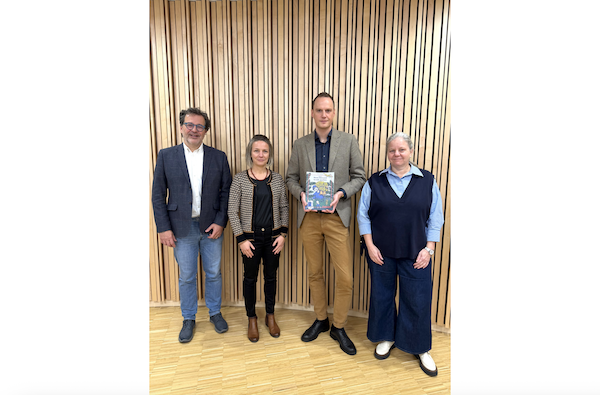
 (L-R) Jean-Louis Zeien, Co-Coordinator of the IDV; Geneviève Krol, Director of ONGD Fairtrade Lëtzebuerg; Robert Bachmann, PublicEye; Denise Richard, Director of Fondation Partage Luxembourg;
Credit: Fairtrade Luxembourg
On Wednesday 18 November 2026, Luxembourg-based organisations ONGD Fairtrade Lëtzebuerg and Fondation Partage Luxembourg, in collaboration with the Initiative for a Duty of Vigilance (IDV), presented the findings of the "Toxic Bananas" investigation by Swiss NGO Public Eye during a press conference held at the Chambre des Salariés (CSL) in Luxembourg-Bonnevoie.
The investigation documents working conditions on plantations supplying Chiquita in Guatemala, highlighting working days of up to twelve hours, wages below the legal minimum and fear of dismissal for joining a trade union. The organisations presented the findings as part of the "Towards Sustainable Futures" consortium, working alongside the IDV, a network comprising seventeen civil society organisations in Luxembourg.
According to Public Eye, workers on Chiquita plantations and those of its subcontractors work days of up to twelve hours, at a pace measured down to the second, for wages that do not allow them to live with dignity. At some subcontractors, payslips examined by the Swiss NGO showed wages significantly below the agricultural minimum wage.
The investigation also reported aerial spraying over plots while people were working there, including during lunch breaks, as well as dismissals following a trade union meeting and unofficial "red lists" that allegedly prevented people considered "problematic" from finding employment again.
Contacted by Public Eye, Chiquita did not respond to the NGO's questions. The organisation called on the company to guarantee the legal minimum wage, stop aerial spraying when people are working on plantations and respect freedom of association.
The organisations also highlighted the imbalance within the banana supply chain, where pressure from large retailers and international buyers to maintain low prices affects plantations and their workers. According to the press release, bananas have become a "traffic-driving product" for large retailers, while plantations face unfair trading practices, including aggressive price pressure, late and unpredictable orders and payment delays.
Responsible purchasing practices for a fairer sector
Geneviève Krol, Director of ONGD Fairtrade Lëtzebuerg, stated: "The answer lies in responsible purchasing practices and fair prices, which are an essential step towards breaking the cycle of human exploitation in supply chains."
She also emphasised: "A low price is never neutral: someone, somewhere, pays the difference. A model based on prices that do not cover production costs is not viable either for those who grow our bananas or, in the long term, for the sector itself. A fair price allows them to invest in their future rather than endure crises."
To break this cycle, the different links in the value chain, from the buyer to the final retailer, must be prepared to pay prices that cover the costs of sustainable production and guarantee decent incomes and wages.
In Luxembourg, ONGD Fairtrade Lëtzebuerg has notably helped bring this demand before the government, resulting in Luxembourg's signing, in June 2023, of the Joint Declaration on Living Wage and Living Income.
However, the organisations stressed that fair prices alone are not enough and that companies must also take responsibility for respecting human rights throughout their supply chains.
Jean-Louis Zeien, Co-Coordinator of the IDV, stated: "A multinational company has a duty of vigilance towards its subcontractors and suppliers throughout its supply chain. In practice, this means that it must identify areas or subcontractors presenting risks in terms of working conditions and put measures in place to stop or mitigate the violations identified. Finally, reporting mechanisms must be established to allow violations linked to the value chain to be reported."
The European Corporate Sustainability Due Diligence Directive (CSDDD) represents an important lever, according to the organisations. They noted that companies established outside the European Union may also be concerned if they generate more than €1.5 billion in net turnover in the EU.
The organisations also highlighted the difficulty of determining whether Chiquita falls under the directive, as its consolidated annual accounts do not provide a breakdown of turnover by geographical region.
Jean-Louis Zeien added: "This lack of transparency makes it difficult to assess its European turnover and, consequently, to determine whether it may be subject to the directive."
For ONGD Fairtrade Lëtzebuerg, Fondation Partage Luxembourg and the Initiative for a Duty of Vigilance, the issue is neither to give up bananas nor to single out one party as responsible, but to work together towards a fairer and more sustainable sector through fair trading practices and respect for workers' fundamental rights.
Denise Richard, Director of Fondation Partage Luxembourg, concluded: "Fair and sustainable food cannot be based on the invisibility of those who produce it. Changing the model is a shared responsibility."
The full Toxic Bananas investigation by Public Eye is available in French and German.