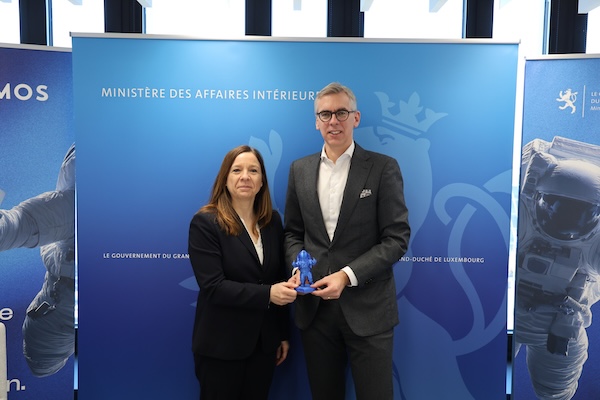
 (L-R) Stéphanie Obertin, Luxembourg's Minister for Digitalisation, Léon Gloden, Luxembourg's Minister of Home Affairs;
Credit: MAINT
(L-R) Stéphanie Obertin, Luxembourg's Minister for Digitalisation, Léon Gloden, Luxembourg's Minister of Home Affairs;
Credit: MAINT
On Monday 2 March 2026, Luxembourg’s Ministry of Home Affairs and Ministry of Digitalisation announced replacing the current e-MINT digital platform for municipalities with COSMOS in order to reflect technological progress and new digitalisation tasks.
Luxembourg's Minister of Home Affairs, Léon Gloden and Luxembourg's Minister for Digitalisation, Stéphanie Obertin presented COSMOS stating that the project marks a concrete step toward more efficient, transparent and closer collaboration with the municipal sector.
The e-MINT platform has served as a digital exchange tool between municipalities and the Ministry of Home Affairs since its launch in 2023. The authorities made it mandatory on 1 February 2025. Since then, around 850 municipal agents and 25 ministry officials have used the system. A 2025 satisfaction survey reported strong user acceptance.
Minister Obertin explained that COSMOS will provide the IT infrastructure required to enable data exchange between municipalities and the State, thereby meeting one of the key conditions for implementing the “once only” principle, which requires administrations to exchange necessary data during a specific procedure and to reuse up to date information in order to reduce errors linked to outdated data, noted Ministry of Home Affairs.
On Saturday 28 February 2026, the authorities published the public procurement notice for the development of the new platform in close cooperation with the Luxembourg Government's central IT administration (CTIE) and the Ministry of Digitalisation.
COSMOS, which stands for communes, syndicats, ministries and social offices, aims to become the central hub for digital exchanges between the State and the municipal sector.
Ministry of Digitalisation highlighted that in addition to managing administrative decisions under municipal law, the new platform will:
• extend its use to other ministries as outlined in the coalition agreement;
• centralise 90 subsidy schemes from ten ministries to provide municipalities with a single and transparent access point;
• create a national register of municipalities which will group official municipal information;
• gradually integrate new procedures including those related to general development plans (PAG) and specific development plans (PAP);
• allow municipalities to track the progress of their applications.
The ministries noted that, developers will begin work in June 2026 after reviewing the public procurement results, and the authorities plan to introduce the subsidy modules and the national register of municipalities in 2027. PAG and PAP procedures are planned to be integrated in a second phase starting in 2028.