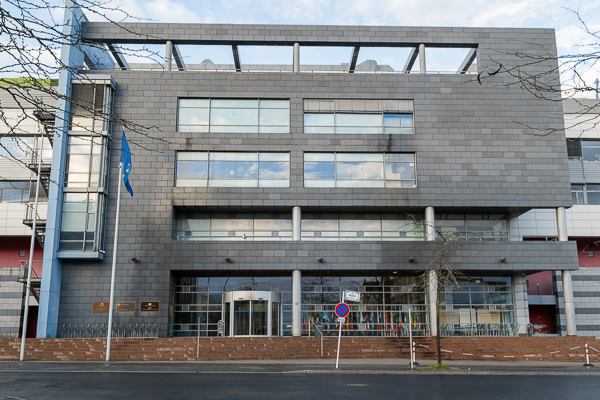
 Eurostat, one of the Directorates-General of the European Commission, in Luxembourg-Kirchberg;
Credit: Ali Sahib, Chronicle.lu
Eurostat, one of the Directorates-General of the European Commission, in Luxembourg-Kirchberg;
Credit: Ali Sahib, Chronicle.lu
Chronicle.lu has compiled a new series of articles dedicated to European institutions, bodies and agencies with a presence in Luxembourg.
Standing alongside Brussels in Belgium and Strasbourg in France, Luxembourg City is one of the European Union's three official seats. A founding member of the European Union (EU), Luxembourg is known internationally as a business and financial hub and hosts several major EU institutions and other bodies.
Based mainly in Luxembourg-Kirchberg, these institutions shape European law, finance and democratic processes and employ around 15,000 international professionals.
Throughout this series, Chronicle.lu will introduce the main European institutions, bodies and agencies in Luxembourg and explain how they work. This article focuses on the European Commission.
The European Commission is the EU's executive body - often described as its "engine". Its responsibilities include proposing new legislation, drawing up the EU budget, ensuring compliance with European law and representing the EU externally. As "Guardian of the Treaties", the Commission, together with the Court of Justice, ensures that EU law is respected.
The Commission comprises one Commissioner per EU Member State (Luxembourg's Christophe Hansen currently serves as Commissioner for Agriculture and Food) and is headed by the President (currently Ursula von der Leyen), who decides on the allocation of responsibilities. Weekly meetings of the College of Commissioners take place primarily in Brussels.
Luxembourg has provided three EU Commission Presidents to date: Gaston Thorn (1981-1985), Jacques Santer (1995-1999) and Jean-Claude Juncker (2014-2019).
The Commission's departments and executive agencies are spread across Brussels and Luxembourg City. Its main site in Luxembourg is the Jean Monnet building - named after one of the architects of European integration. The Luxembourg offices focus largely on administrative, translation, statistical and publication functions supporting the broader work of the Commission.
Key EU Commission bodies based in Luxembourg include:
- Eurostat, the EU's statistical office, which collects and publishes data used to inform European policy-making;
- the Publications Office of the European Union, responsible for publishing EU legislation and documents, including the Official Journal of the European Union, and managing platforms such as EUR-Lex and the EU Open Data Portal;
- parts of the Directorate-General for Translation (DG Translation), which ensures EU legislation and documents are available in all official EU languages;
- certain administrative, financial and internal support services contributing to the Commission’s overall operations.
In addition, the Representation of the European Commission in Luxembourg acts as the institution's local voice, liaising with national authorities, media and citizens. The current Head of Representation is Anne Calteux.
The Commission also maintains four Europe Direct Information Centres across Luxembourg - in Munshausen, Schengen, Esch-Belval (University of Luxembourg) and Luxembourg-Bonnevoie.
JCA/EO