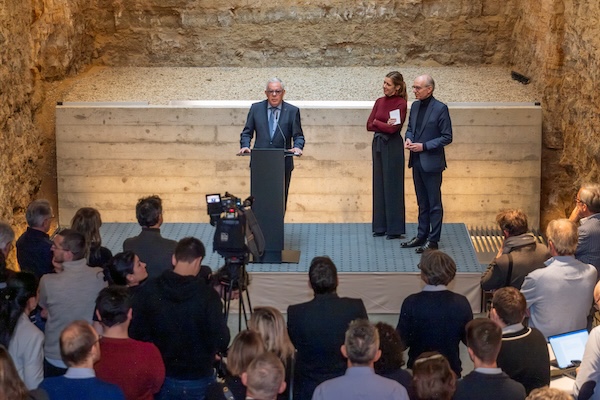
 Luxembourg Press Council General Secretary Roger Infalt speaks at the 2026 New Year's Reception for the press, hosted by the Luxembourg government;
Credit: Ali Sahib, Chronicle.lu
Luxembourg Press Council General Secretary Roger Infalt speaks at the 2026 New Year's Reception for the press, hosted by the Luxembourg government;
Credit: Ali Sahib, Chronicle.lu
Each year on 3 May, people, governments and organisations around the globe mark World Press Freedom Day - an occasion established by the United Nations (UN) in 1993 to highlight the importance of a free and independent press.
According to the UN, press freedom and independent journalism are "key to peace, economic recovery, sustainable development and human rights". And yet, in recent years, press freedom has come under increasing pressure around the world.
Ahead of World Press Freedom Day 2026, Reporters Without Borders (RSF) warned of a global decline in press freedom. While Luxembourg climbed four places to ninth in this year's World Press Freedom Index, the broader international trend remains concerning. "In 25 years, the average score of all 180 countries and territories surveyed in the Index has never been so low," RSF stated, adding that the index's legal indicator witnessed the most significant decline over one year - "a clear sign that journalism is increasingly criminalised worldwide".
According to UNESCO, press freedom has experienced its "steepest decline" since 2012, amid "political, social and commercial pressures [on] media freedom, plurality and diversity". Among the challenges are disinformation and information manipulation - increasingly amplified by artificial intelligence (AI) and other digital platforms.
In this context, Luxembourg's relatively strong position should not be taken for granted. The right to freedom of expression and press freedom is also protected in Luxembourg's Constitution, forming a key legal foundation for media independence. As someone who has worked in journalism in Luxembourg for almost a decade, I consider myself fortunate to practise this profession in a country where journalists generally have good access to politicians, institutions and public information. Compared to many parts of the world, journalists here can, to a large extent, work without fear of imprisonment, violence or intimidation simply for doing their jobs.
However, that does not mean the situation is perfect. Even in Luxembourg, tensions surrounding journalism have become more visible in recent years, particularly during the COVID-19 pandemic. In early 2022, the Luxembourg Association of Professional Journalists (ALJP) issued an open letter condemning aggressive behaviour towards journalists and media workers. One photographer was verbally assaulted while covering an anti-vaccine protest, while another journalist reportedly received death threats via Telegram. These incidents may not compare to the dangers faced by journalists in war zones or authoritarian regimes, but they nevertheless serve as reminders that press freedom can never be entirely taken for granted.
Indeed, the one area of the RSF's latest index in which Luxembourg performed worse than the previous year was the security category - dropping from first to third place. This serves as a reminder that protections for the press can evolve - for better or worse.
At the same time, important discussions are taking place in Luxembourg around media reform, improved access to information and journalist protections. The proposed reform also seeks to modernise the definition of media actors themselves, with discussions on whether influencers and digital content creators should fall within the scope of press accreditation, reflecting broader efforts to adapt media regulation to a changing information landscape. It remains to be seen how this would work in practice, particularly given differing transparency expectations between traditional media and influencer marketing, including requirements around sponsored content.
Recent debates surrounding reforms to access official documents have also highlighted concerns that Luxembourg still lags behind some other European countries in terms of transparency. As mentioned in the Prime Minister's 2026 State of the Nation address, the government has pledged to improve press aid, strengthen access to information and enhance protections against strategic lawsuits against public participation (SLAPPs) as part of broader efforts to safeguard democracy.
Elsewhere, the risks facing media professionals are even greater. According to the Committee to Protect Journalists (CPJ), 2025 was the deadliest year for journalists and media workers since the organisation began collecting data more than 30 years ago. An estimated 129 members of the press were killed that year - a new and deeply troubling record. Many of those deaths occurred in conflict zones, particularly in Gaza and other parts of the Middle East. The CPJ stated "Israel was responsible for two-thirds of all press killings" in the past two years, adding that the majority of such killings around the world remain unsolved.
Even in "the West", notably in the United States (US), press freedom is under strain. The US dropped seven places in the latest RSF index to 64th, a development the organisation attributed to the US President's "systemic policy" of attacking the press and journalists, as well as "drastic cuts" to the US Agency for Global Media (USAGM) workforce. A number of Latin American countries also saw declines in their rankings.
Journalists thus continue to face imprisonment, harassment, censorship and violence across the globe - often simply for attempting to document events and inform the public. In addition to physical threats, independent media outlets are increasingly confronting financial instability, declining advertising revenues (especially post-COVID), shrinking newsrooms and growing public distrust.
UNESCO has also highlighted a rise in self-censorship among journalists worldwide. In an era dominated by algorithms, misinformation and often emotionally charged social media content, rigorous journalism may sometimes struggle to compete with faster and louder forms of digital communication. This may in turn create a dangerous environment for democracy.
Indeed, a functioning democracy depends on citizens having access to reliable, verified information. Without independent journalism, it becomes far easier for misinformation, propaganda and political manipulation to flourish unchecked. A free press is above all about protecting the public's right to know the facts.
Luxembourg, to its credit, has recognised many of these challenges. Ahead of this year's World Press Freedom Day, the Ministry of Culture and the Luxembourg Commission for Cooperation with UNESCO reaffirmed the importance of protecting press freedom and professional ethics. On Monday 1 June 2026, the Luxembourg government is also due to hold a conference at Neumünster Abbey on protecting journalists from SLAPPs and presenting the national action plan for journalists' safety.
The Grand Duchy also benefits from structures that help support media pluralism, including state press aid schemes and professional standards linked to the national press card system. In a small country such as Luxembourg, where the media landscape is relatively limited and journalists often operate in close proximity to political and economic power, maintaining independence, transparency and public trust is especially important.
Of course, journalism is not infallible. Journalists make mistakes. Media organisations are not immune from bias (although hopefully less so in Luxembourg today), poor judgement or financial pressures. Public criticism of the media is both legitimate and necessary in a democratic society. However, there is an important difference between constructive criticism and the deliberate undermining of trust in journalism as an institution.
In recent years, terms such as "fake news" have too often been weaponised to discredit inconvenient reporting, while journalists around the world increasingly find themselves targeted (particularly online) simply for doing their jobs. The growing hostility directed towards the press may also deter some journalists - especially younger reporters - from covering certain topics, to the detriment of public understanding and freedom of the press.
And yet, despite these challenges, journalism remains essential. Strong independent journalism can inform, investigate, explain and hold power to account. It gives visibility to issues that might otherwise be ignored and amplifies voices that might otherwise go unheard. It also helps societies make sense of increasingly complex and fast-moving events.
The recent 100th anniversary celebration of the ALJP in Luxembourg offered a moment not only to reflect on the past but also to consider the future of journalism. In an age of AI-generated content, disinformation and declining trust, safeguarding independent journalism is more important than ever. As Anthony Bellanger, Secretary General of the International Federation of Journalists, said at the event, it is essential to prepare for "a future where journalism remains free, protected and recognised for what it is". Similarly, Luxembourg's Prime Minister, Luc Frieden, stressed the need for "a strong, independent press" for democracy.
Press freedom is not only a concern for journalists; it affects all of us. Ultimately, a free and independent press contributes to a society with a strong democracy - something especially important in today's increasingly uncertain and unstable world. Efforts to protect journalists' safety and preserve press freedom are thus essential to both ensure an informed public and uphold free speech.