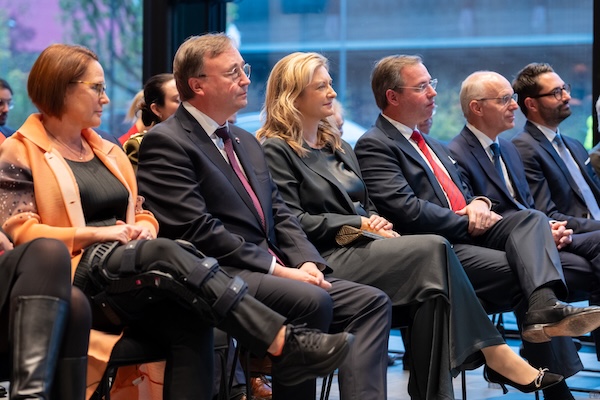
 (L-R) Yuriko Backes, Minister for Mobility and Public Works; André Bauler, Vice-President of the Chamber of Deputies; Grand Duchess Stephanie; Grand Duke Guillaume; Luc Frieden, Prime Minister; Eric Thill, Minister for Culture;
Credit: SIP / Emmanuel Claude
On Friday 23 October 2026, Luxembourg's Ministry of Mobility and Public Works, Ministry of Culture, Fonds Belval and National Archives jointly announced the inauguration of the new National Archives building in Belval.
The inauguration took place in the presence of Grand Duke Guillaume and Grand Duchess Stéphanie, Luxembourg's Prime Minister Luc Frieden, Minister for Mobility and Public Works Yuriko Backes, Minister for Culture Eric Thill, as well as numerous institutional and local representatives.
According to the joint statement, the new building brings together all administrative, logistical, conservation and public reception functions of the National Archives on a single site. Located in the heart of the City of Science, Research and Innovation, the infrastructure marks a major step in the preservation, study and transmission of Luxembourg's documentary heritage.
Minister Backes stated: "In Belval, where Luxembourg's industrial heritage now meets knowledge, research and innovation, the National Archives have found their place. This project demonstrates that preserving our memory and building the future are part of the same responsibility." She added: "Public infrastructure must be designed to meet needs far beyond the immediate future: it must protect our heritage, support present generations and create lasting value for those to come. This is the ambition we have realised here through infrastructure that is resilient, innovative and exemplary in terms of sustainability."
Minister Thill emphasised the importance of an ambitious national archival policy: "The documents preserved in this building tell our shared history. They allow us not only to trace our origins, but also to interpret our present. At a time when public debate is threatened by disinformation and the dilution of facts, maintaining an excellent archival policy becomes a matter of democratic responsibility."
Preserving traces of the past, passing them on to the future
As the national institution responsible for documentary heritage, the National Archives collect, preserve and make available public and private archives of national interest. They preserve records of Luxembourg's history and make them accessible to the general public, as well as to the academic and scientific communities.
Through exhibitions, conferences, symposiums, educational workshops and guided tours, the National Archives also help the public discover the richness of the written heritage preserved in their collections and raise awareness of its importance. Following their relocation to Belval, these activities will gradually resume to continue this work of promoting and passing on documentary heritage.
Belval: a place of heritage, knowledge and innovation
Developed by Fonds Belval as part of the City of Science, Research and Innovation project, the new building establishes the National Archives in Belval, within an environment dedicated to knowledge, research and innovation. Its location encourages cooperation with the University of Luxembourg and the research centres based on the site.
Designed specifically for archival purposes, the building brings together conservation, consultation, document processing and working areas across a usable floor area of 17,399 m².
According to the joint statement, the building contains 56 storage repositories that meet international conservation standards and provide approximately 108.5 linear kilometres of shelving. Designed to accommodate existing collections and additional records expected over the next 25 years, the building provides the National Archives with facilities suited to their responsibilities.
Sustainable infrastructure for future generations
Designed according to demanding sustainable construction principles, the building prioritises materials with a low environmental footprint and incorporates innovative energy solutions based notably on solar and geothermal energy. This approach has two objectives: ensuring optimal conservation conditions while reducing the environmental impact of the infrastructure.
According to the statement, the building produces more energy than it consumes. Its façades and roof generate approximately 650,000 kWh of electricity annually, compared with estimated annual consumption of 433,000 kWh.
The opening ceremony concluded with an inaugural gesture and the symbolic handover of the building's key. A guided tour then allowed guests to discover the reading rooms, archive processing facilities, administrative areas and storage repositories.
Guests also had the opportunity to view a photographic exhibition dedicated to the construction of the new building, entitled "Archives nationales, partition moderne", in the presence of artists Éric Chenal and Xavier Pompelle.
With this new infrastructure, the National Archives now have the capacity to ensure the long-term preservation, promotion and transmission of Luxembourg's documentary heritage for present and future generations.