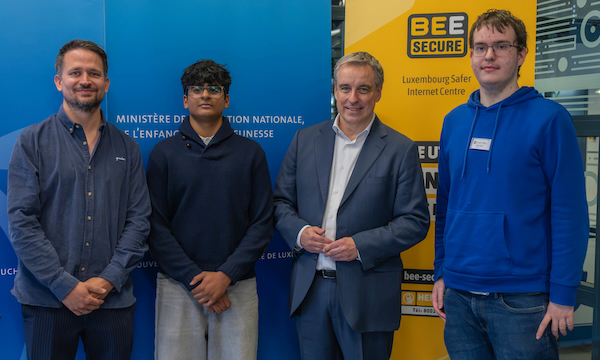
 Claude Meisch, Luxembourg Minister for Education, Children and Youth, helps launch Gënn dir eng Paus vum Scrollen campaign;
Credit: MENEJ
On Monday 16 November 2026, Luxembourg’s Ministry of Education, Children and Youth reported on the launch of the Gënn dir eng Paus vum Scrollen (Give Yourself a Break from Scrolling) campaign.
According to the ministry, the campaign, officially presented by Luxembourg’s Minister for Education, Children and Youth, Claude Meisch, encourages young people to become aware of certain automatic behaviours, particularly when scrolling through content without really paying attention to it, adding that social media plays an ambivalent role in young people’s everyday lives, offering the pleasure of communication while also making it difficult to disconnect.
Led by the Ministry and BEE SECURE, the campaign forms part of the Screen-Life-Balance initiative, which promotes conscious use of digital technology and a better balance between digital activities and offline pursuits.
“The time many young people spend scrolling through content on their smartphones is time wasted. When scrolling becomes automatic and a few minutes spent on a smartphone turn into hours without us even realising it, it is essential to raise young people’s awareness of the importance of questioning their own habits. This screen time comes at the expense of their well-being, mental health and real-life experiences. Through this campaign, we want to encourage young people to use digital media more consciously, regain control of their time and find a healthy balance between the digital world and real life,” emphasised Minister Meisch.
Understanding Why It Can Sometimes Be Difficult to Stop
The ministry said the way platforms operate can encourage users to spend longer scrolling than they realise. Infinite scrolling, recommendation algorithms that continuously suggest new content and the fear of missing out (FOMO) are all mechanisms that can make it more difficult to stop scrolling.
These findings are directly reflected in the results of the 2025 National Report on the Situation of Young People in Luxembourg – Living and Growing Up Online and Offline. Around 80% of young people aged between twelve and 29 spend two hours or more on social media every day and appreciate the opportunities it offers for communicating, accessing information and entertainment.
However, the report also shows that young people, particularly those aged sixteen to 29, are becoming increasingly critical of their screen time. Time spent scrolling through news feeds can be perceived as a waste of time and may even be accompanied by a feeling of losing control. The findings of the BEE SECURE Radar 2026 point in the same direction: 59% of young people aged between seventeen and 30 surveyed as part of the study believe that social media has a negative impact on their mental well-being.
The ministry noted that these findings highlight the important role social media plays in young people's everyday lives and social relationships. They also reveal a growing awareness of the time they spend on these platforms and the difficulties they experience in disconnecting from them.
“It is precisely this ambivalence that the campaign seeks to address. It encourages more conscious use without making users feel guilty, particularly in situations where scrolling becomes more of a reflex than a choice. The message Gënn dir eng Paus vum Scrollen encourages young people to recognise these automatic behaviours and consciously take a break, without judgement or pressure,” said the ministry.
A Campaign Building on the Screen-Life-Balance Initiative
Primarily aimed at young people aged between twelve and 30, the campaign was developed in collaboration with young members of BEE SECURE's Digital Ambassadors group, who contributed to discussions about scrolling habits, the situations portrayed and the messages to be conveyed.
Three videos, inspired by the advertising aesthetics of the 1950s, humorously portray familiar situations in which scrolling becomes automatic: before going to sleep, during a break with friends or in a waiting room.
The videos will be shared on social media platforms, including Facebook, Instagram and TikTok. The videos' retro aesthetic is also carried over into an activity booklet featuring analogue activities. It brings back games, puzzles and little challenges that people enjoyed long before the arrival of smartphones, offering simple alternatives to moments spent scrolling. The booklet will, among other things, be distributed during BEE SECURE training sessions.
Public advertising in busy locations, particularly at Luxembourg Central Station, will further increase the campaign's visibility.
Further Information
The website www.bee-secure.lu/paus provides further information about scrolling and the campaign.
The phenomenon of scrolling is also addressed, among other topics, during various BEE SECURE information evenings for parents (https://www.bee-secure.lu/fr/evenements/).
Through these various initiatives, BEE SECURE reiterates a simple message: recognise more easily when scrolling becomes automatic, know when to take a break and give yourself the opportunity to enjoy your time in other ways.
The campaign forms part of the activities for young people already being carried out by the ministry under the Screen-Life-Balance initiative. These include the MoVe programme, which offers accessible sporting activities for young people, primarily during school holidays, and the CreativeLab programme, which gives secondary school pupils the opportunity to take part in cultural and creative activities outside school hours.