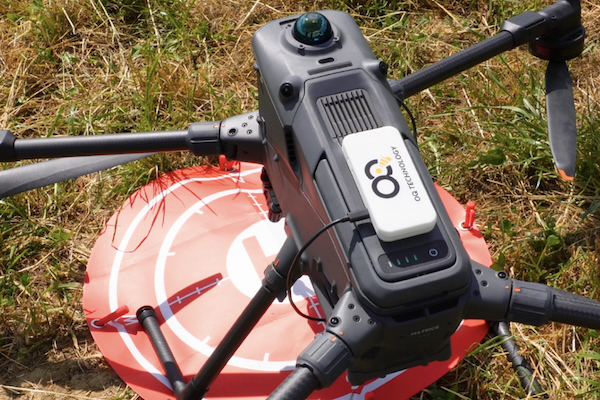
 Credit: OQ Technology
On Wednesday 24 June 2026, Luxembourg-based satellite connectivity provider OQ Technology announced the successful completion of Europe’s first drone video transmission over a Low Earth Orbit (LEO) satellite network using standardised 3GPP NTN technology and MSS S-band spectrum.
According to OQ Technology, the demonstration transmitted a video from a compact drone through OQ Technology’s sovereign European satellite constellation using MSS S-band spectrum and a standards-based 3GPP NTN IoT architecture and a secure cloud in Europe. The company said the achievement marked a major milestone for sovereign European space communications and demonstrated how video services can be delivered from lightweight drones without the need for large, power-hungry satellite terminals.
Unlike traditional satellite drone communications that rely on bulky and expensive VSAT or broadband satellite equipment, OQ Technology’s direct-to-device approach uses a compact 3GPP standard-based NTN IoT modem integrated directly into the drone. Video is processed and compressed using edge computing onboard the drone before being transmitted efficiently through a narrowband satellite link, significantly reducing size, weight, power consumption and deployment costs.
OQ Technology detailed that the demonstration was conducted entirely over its LEO satellites and network and validated the ability of drones, IoT devices and smartphones (iPhone, Google, Samsung) to operate seamlessly over a unified 3GPP-compliant NTN network.
“This achievement demonstrates the growing maturity and strategic importance of standardised 3GPP NTN technology for Europe,” said Omar Qaise, Founder and CEO of OQ Technology. “For the first time, we have demonstrated drone video transmission through a European direct-to-device LEO satellite network using compact hardware and MSS S-band spectrum rather than large satellite terminals. This opens entirely new possibilities for emergency response, infrastructure monitoring, maritime awareness, border surveillance, public safety and other mission-critical operations where terrestrial networks are unavailable.”
Moreover, OQ Technology highlighted that the demonstration showcased three practical use cases enabled through satellite-connected drones: infrastructure monitoring; traffic surveillance; and autonomous drone guidance toward a designated destination.
The company said these capabilities illustrate how NTN-enabled drones can support civilian, governmental and enterprise operations in remote, disconnected or disaster-affected environments. Potential applications for the technology include disaster response and rescue coordination during floods and wildfires, critical infrastructure monitoring, maritime and border awareness, environmental monitoring and real-time situational awareness in areas beyond terrestrial coverage.
OQ Technology said: “This milestone further reinforces Europe’s ambitions for sovereign, secure and resilient communications infrastructure under initiatives such as IRIS² and the European Union’s broader strategic autonomy agenda. It also highlights OQ Technology’s role in extending digital connectivity beyond terrestrial coverage and bringing direct-to-device satellite communications to even the smallest connected devices.”