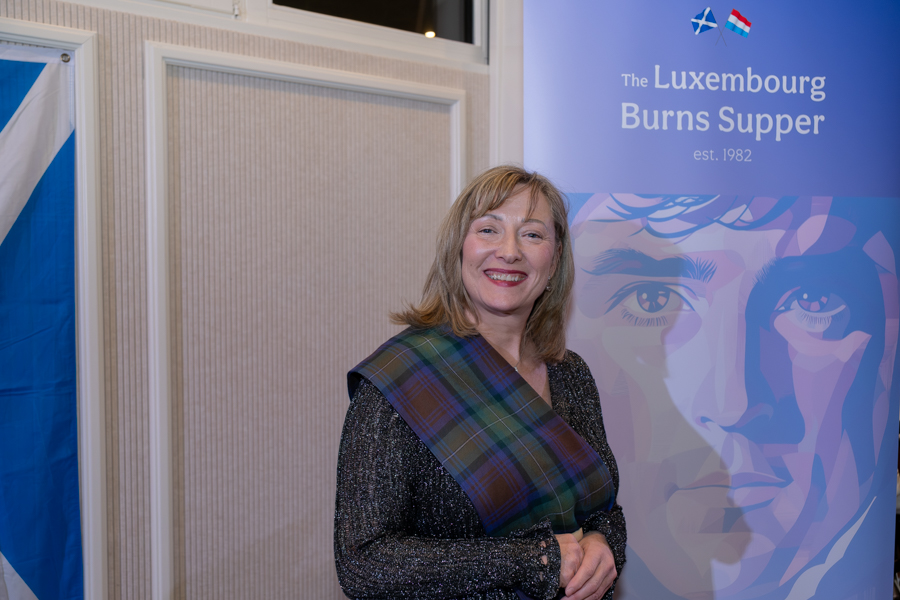
 Margaret Ferns, committee member of The Scottish Cultural Association of Luxembourg;
Credit: Ali Sahib, Chronicle.lu
Ahead of St Andrew's Day on Monday 30 November 2026, Chronicle.lu spoke to Margaret Ferns of the recently established Scottish Cultural Association of Luxembourg about how the association came to be, the significance of St Andrew’s Night and the celebrations of Scottish tradition one can now enjoy in the Grand Duchy.
St Andrew's Day is celebrated annually on 30 November in honour of Saint Andrew, the patron saint of Scotland. Unlike well-known national days in countries such as France (Bastille Day) and the US (4th of July), St Andrew's Day is rarely marked with significant celebrations and is not recognised as a national holiday in Scotland. However, this does not mean that it holds little significance for those in Scotland or Scots living elsewhere.
History states that Andrew was born in Bethsaida, near the Sea of Galilee, in what is now Israel, and worked as a fisherman alongside his brother Simon Peter, with both becoming apostles of Jesus.
According to Christian tradition, St Andrew was martyred in Patras, Greece, around 60 AD during the reign of the Roman Emperor Nero. Legend says he was crucified on an X-shaped cross, which would become an influence for the design of Scotland’s flag, known as the Saltire or St Andrew's Cross. His feast day, 30 November, is traditionally associated with the anniversary of his martyrdom.
Despite no historical evidence that Saint Andrew ever visited Scotland, he became the country's patron saint through religious traditions and legends and, over time, increasingly significant to the Scottish Church and national identity.
Margaret arrived in Luxembourg in 1996, working as a journalist for various publications over the years, as well as occupying various communications management roles for high-profile businesses as well as the University of Luxembourg. Over her career she has interviewed prime ministers, business leaders and former US Vice President Al Gore. Today, she is heavily involved in the running of The Scottish Cultural Association in Luxembourg.
Chronicle.lu: Having existed in a previous form, can you provide some background on how the Scottish Cultural Association of Luxembourg came to be?
Margaret Ferns: The Scottish Cultural Association was formerly the Burns Supper Committee. We established the Association in order to bring more Scottish culture to Luxembourg (it is not all haggis and whisky). In addition, and very importantly, it was also established to raise funds for our leading event, the Burns Supper, which has become increasingly expensive to run, and we do not want to be forced to increase the ticket prices.
Chronicle.lu: The flagship event for the association is undoubtedly the annual Burns Supper. What other events is the association aiming to organise in the future?
Margaret Ferns: In spring this year, we organised a fun event called the “Mince an’ Tatties Night”, along with a ceilidh, which was a huge success. We hope to be able to organise this event again next year. Going forward we have ideas for future events such as a “Whisky and Words” event where participants would have a chance to read from their favourite Scottish writers and poets while having a wee “dram” (the Scottish vernacular for a measure of whisky). I am certain that the works of Robert Burns will make an appearance at this event too.
Additionally, we are considering a “Jean Armour Day” to celebrate the life of Burns’ wife, as well as other inspiring women from throughout the ages. A quiz night is also in the pipeline, and we cannot forget a St Andrew’s Day celebration.
It is important to say that in order to put all of this into action it is essential that we find suitable (free or inexpensive) venues as well as sponsors to keep costs down. We also need volunteers to help us organise and run the events. I cannot emphasise this enough.
Chronicle.lu: The Scottish diaspora in Luxembourg reduced notably following the United Kingdom’s departure from the European Union, yet the popularity of events such as the Burns Supper continues to grow and people of other nationalities in Luxembourg are embracing Scottish cultural events in the country. Why do you think this is?
Margaret Ferns: Most definitely. Although it is mostly Luxembourg’s Scottish population, we also have attendees from other European countries and we have also seen an increasing number of Russians attend, as Robert Burns is hugely popular in Russia. In addition, we have participants from the US and Canada. Native Luxembourgers love the Burns Supper too.
As to why, it is because the works of Robert Burns are wonderful and timeless and his appeal is global. The popularity of TV shows like Outlander has also resulted in more and more people becoming interested in Scotland and its culture. It could also be the fact that the Scots are amazing! Just think of the Tartan Army and their positive impact at this year’s World Cup in the US.
Chronicle.lu: Although St Andrew’s Day is celebrated in Scotland it does not carry the significance of events such as Burns Day or Hogmanay. What are your thoughts on this and what would the association like to do to commemorate Scotland’s patron saint?
Margaret Ferns: St Andrew’s Night, Scotland’s national day, is not like a Burns Supper in that there is no traditional format to follow. Although St Andrew’s Day has a national identity, Burns Night and Hogmanay have developed a strong cultural identity.
That said, St Andrew’s Day has featured more prominently in Scotland since the re-creation of the Scottish Parliament and we hope to bring this to Luxembourg and plan to hold a celebratory event in future, perhaps with other groups such as the Scottish Country Dancing Association and university alumni groups. We would like to be more adventurous, more cultural. It does not have to be haggis and whisky every time!
Further information about the Scottish Cultural Association can be found here.