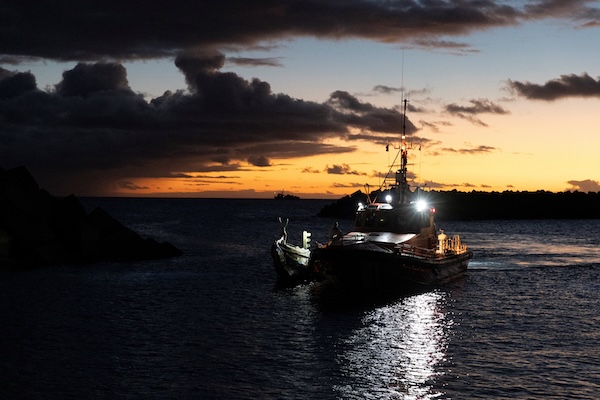
 Spanish coast guard vessel tows a wooden fishing boat carrying the bodies of migrants at the port of La Restinga, on the island of El Hierro, Spain, Friday 27 November 2026;
Credit: REUTERS/Jesus Cabrera
MADRID (Reuters) - Fourteen migrants were found dead after a boat carrying about 100 people was rescued near Spain's Canary Islands, Spanish news agency EFE reported on Friday 27 November 2026, as a surge in arrivals overwhelms authorities in the region.
The deaths highlight the dangers of one of the world's deadliest migration routes just days before the general election in Spain on Sunday 29 November, ahead of which immigration has emerged as a defining campaign issue.
EFE said 14 bodies had been brought ashore. The maritime rescue service had earlier said between eight and ten bodies were found on board and six people were airlifted to a hospital in serious condition. The boat, discovered 39 nautical miles (72 km) south of the island of El Hierro, was being towed to the port of La Estaca.
Eighty-four survivors disembarked from a separate boat at the island's La Restinga port, home to a migrant reception centre and field hospital where most migrant boats reaching the island have been processed.
Daily arrivals hit all-time high
Migrant arrivals to the Canary Islands have accelerated since October, hitting a record 2,100 people in a single day on November 25, most of them coming to El Hierro, population 11,400.
"A lot of pain and feeling of impotence over this new tragedy," regional leader Fernando Clavijo said in a post on X, demanding action from the Spanish government and the European Commission.
"The humanitarian emergency doesn't start on El Hierro, but on the shores of Senegal and Gambia, where we have to act," he wrote.
Prime Minister Pedro Sanchez is one of Europe's loudest advocates of immigration's benefits for the economy, while the right, which leads in opinion polls, wants far tighter controls.
Thousands of migrants attempt the Atlantic crossing each year in overcrowded boats, seeking to reach Spanish territory despite rough seas and strong currents. Arrivals typically pick up in the autumn, when sea conditions are generally more favourable.