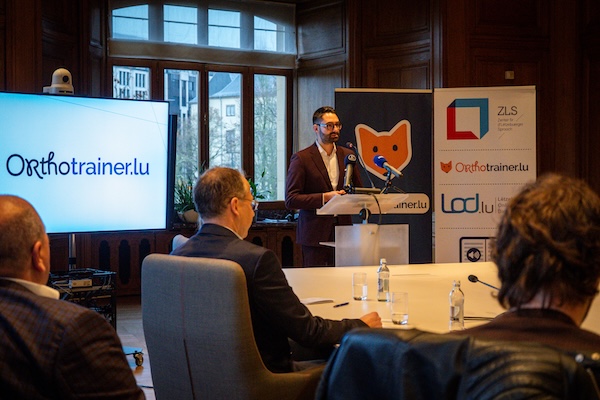
 Eric Thill, Luxembourg's Minister of Culture;
Credit: MCULT
Eric Thill, Luxembourg's Minister of Culture;
Credit: MCULT
On Monday 8 December 2025, Luxembourg’s Minister of Culture Eric Thill, together with the Centre for the Luxembourgish Language (ZLS), presented four new or revised tools designed to further strengthen the Luxembourgish language in the digital space and simplify its use for the general public.
On this occasion, Minister Thill emphasised that this action represents another significant stage in the implementation of the action plan for the Luxembourgish language, and in this context highlighted the importance of the digital component: “We have set out to position the Luxembourgish language clearly and visibly in the digital space as well. With these tools, we are taking a big step forward, for accessibility, for the quality of services and also for the joy of learning.”
The Ministry of Culture and ZLS reported that the Orthotrainer, a platform for practising Luxembourgish orthography, reviewing rules and completing exercises, has been fundamentally modernised and is now available on a new, user-friendly website. A mobile app is scheduled to follow. The institutions noted that particular emphasis was placed on accessibility: after consultations with the Centre de développement des compétences relatives à la vue (CDV - centre for the development of vision-related skills), the site was contrast-optimised and can be used with the OpenDyslexic font.
The updated Orthotrainer now includes more than 400 exercises, a pedagogically structured learning path and a theory section with detailed explanations, also available as a PDF download. The tool additionally prepares users for the ZLO test, the Luxembourgish orthography certificate of the INLL.
The ministry and ZLS also presented version 2.0 of the language engine, the AI-based tool that recognises and transcribes spoken language and reads written texts aloud. The new version features improved speech recognition and was trained on twice as much data as the previous model, resulting in fewer errors. The update introduces speaker recognition, allowing the system to distinguish between voices, and offers the option of having texts read aloud by a female voice alongside that of Max Kuborn.
The institutions added that accessibility was again a key focus: the site is compatible with screen readers, offers a dark mode and supports the OpenDyslexic font.
A further development concerns the Luxembourgish Online Dictionary (LOD), which will now include Dutch as an additional target language alongside German, French, English, Portuguese and sign language. The Dutch version, nl.lod.lu, was developed with the support of two volunteers who contributed more than 30,000 translations. The ministry and ZLS described this as a “proof of concept” intended to encourage future volunteer contributions for additional language versions. The Dutch version is also expected to be of interest to the tourism sector, with the Directorate General of Tourism collaborating on its further use and promotion.
The institutions reported that the ZLS spellchecker will soon be available as an app. In parallel, discussions continue with Microsoft to further integrate Luxembourgish into the MS Office suite, including Word and Outlook, while talks are also under way with Apple to bring the language to iOS platforms.