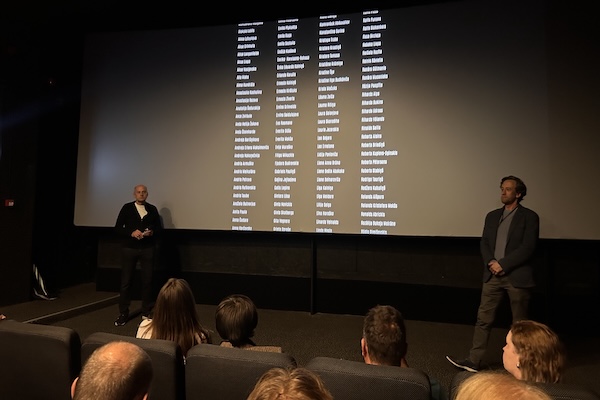
 (L-R) Guntis Trekteris; n/a;
Credit: Elza Osmane, Chronicle.lu
On Sunday 18 October 2026, CinEast, the Central and Eastern European Film Festival in Luxembourg held seventeen screenings and events across seven venues in Luxembourg.
The screening of Ulya (Uļa) took place at Ciné Utopia in Luxembourg-Limpertsberg at 18:30, drawing a capacity audience. Following the film, attendees had the opportunity to participate in a question-and-answer session with producer Guntis Trekteris.
Directed by Viesturs Kairišs, the Latvian coming-of-age drama follows Uljana Semjonova, an unusually tall teenage girl who goes on to become a prominent Latvian basketball player. Set in Soviet-era Latvia during the 1960s, the film combines humour and melancholy as it explores her journey towards sporting success, while also offering a glimpse into everyday life under Soviet rule. The film is presented in Latvian and Russian with English subtitles.
Following the screening, which lasted approximately one hour and 40 minutes, audience members had the opportunity to ask Guntis Trekteris several questions, including about the symbolism behind particular scenes, the director's approach to making a sports-related film and the research involved in portraying the real-life Uljana Semjonova.
Discussing the preparation process, he explained that the lead actor Kārlis Arnolds Avots, who portrayed Uljana, had been interested in her story since the early years of his acting career. After several unsuccessful attempts to contact her, he eventually received a response and invited her to be involved in the film. He then spent around two years meeting and speaking with her, getting to know her personally and learning more about her life to prepare for the role.
Speaking with Chronicle.lu after the screening, Radek Lipka, CinEast Festival Director, said that Sunday had been one of the festival's busiest days, during which he personally presented eight films, a record for him across all editions of the festival.
Commenting on attendance halfway through the festival, he said turnout had exceeded expectations, although not every screening had sold out. He highlighted two recently added Polish films that quickly sold out, as well as films previously screened at Cannes, which had attracted considerable interest. He also noted that attendance could depend on several factors, including competing screenings, venue locations and parking difficulties.
Radek Lipka also highlighted the festival's focus on Bulgarian cinema, including a recent screening and gathering at Neumünster Abbey (neimënster), organised with the support of the local Bulgarian association, Club Gaida.
Beyond the film screenings, he emphasised the festival's social aspect, which gives audiences opportunities to meet filmmakers and exchange opinions. "It's not just about the movie. You can also talk to people after," he said.