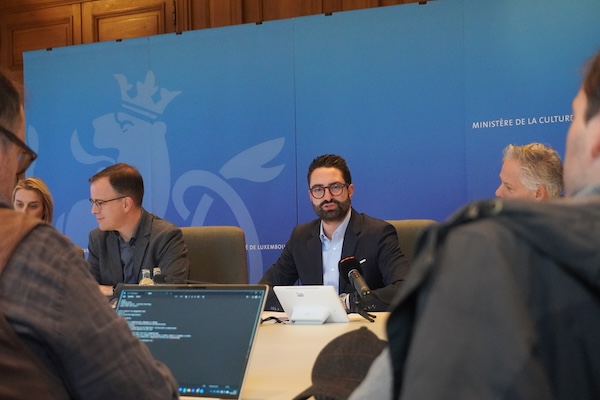
 (L-R) Beryl Bruck, Head of the Cultural Heritage Department at the Ministry of Culture; Carl Adalsteinsson, First Government Adviser at the Ministry of Culture; Eric Thill, Luxembourg's Minister of Culture; Jo Kox, President of the National Cultural Fund;
Credit: MCULT
On Thursday 26 November 2026, Luxembourg's Ministry of Culture reported on the presentation of a draft law on the promotion of cultural patronage and philanthropy and the reorganisation of the National Cultural Fund (Focuna).
Luxembourg's Minister of Culture, Eric Thill, presented the draft law to members of the press. According to the ministry, the draft law proposes modernising the legal framework dating from 1982 to take into account both the developments in the cultural sector over recent decades and the gradual expansion of Focuna's activities.
Minister Thill emphasised: "With this reform, we wish to give cultural patronage new momentum by diversifying forms of patronage and encouraging new forms of engagement. Our ambition is to make the National Cultural Fund a real driving force for cultural patronage, capable of connecting the cultural sector, businesses and citizens." He added: "Patronage should complement public funding for culture, without replacing it, and thereby contribute to diversifying the resources of our cultural sector."
A five-priority reform
The modernisation of legislation relating to cultural patronage is structured around five priorities:
1. Diversifying forms of cultural patronage
The draft law expressly incorporates skills-based patronage into the legal framework, alongside financial donations and donations in kind. Businesses and individuals will thus be able to support cultural projects by providing their expertise, offering services free of charge or making personnel available.
2. Broadening access to donations
The draft law broadens and clarifies the range of beneficiaries eligible to receive donations through Focuna. In addition to state cultural institutes and public establishments under the supervision of the Minister of Culture, organisations pursuing a mission of general interest in the fields of culture, the arts or cultural heritage will be eligible, subject to approval. The possibility of approving a specific cultural activity is retained, allowing artists and project organisers to continue to seek donations through the Fund.
3. Facilitating fundraising and encouraging new partnerships
Focuna will be entrusted with the task of providing a fundraising platform. This will enable cultural stakeholders to seek contributions more easily and patrons to identify and support projects.
4. A clear tax framework for cultural patronage
The draft law amends tax legislation to clarify the deductibility rules applicable to monetary donations, donations in kind and skills-based donations. An assessment committee comprising representatives of the ministries of Culture and Finance will be responsible for assessing the cultural interest and value of donations in kind and skills-based donations.
5. Modernising Focuna and strengthening its governance
The rules governing Focuna's governance, oversight and transparency will be harmonised with those of other public establishments under the supervision of the Ministry of Culture. The responsibilities of the Board of Directors will be clarified and its composition revised. It will comprise three state representatives and two independent members from the cultural or philanthropic sectors. A multiannual agreement with the state will enable the Fund to plan its activities and funding over several years.
According to the ministry, the draft law is intended to enter into force on 1 January 2028.